
Here is the uncomfortable truth: a healthy limit and an unhealthy one can use the exact same sentence. The difference is everything that lives underneath it.
Two women can both say "I need space when I am overwhelmed." One of them is protecting her nervous system so she can come back to the conversation with more to offer. The other is disappearing for four days and calling it a limit because it sounds better than admitting she is punishing him for something he did not know was wrong. Same words. Completely different things.
The difference between healthy and unhealthy limits in a relationship is not in what you say. It is in the purpose it serves, the consistency with which it is applied, and whether it protects your wellbeing or controls someone else's behavior. This comparison covers eight dimensions where the two look similar enough to confuse you, and different enough to matter enormously.
Purpose: protection versus punishment
This is the one that cuts through everything else. Ask yourself honestly: what is this limit actually for? If the answer is that it protects your emotional safety, your time, your physical wellbeing, or your ability to show up as yourself, that is a healthy limit. If the answer is that it makes him feel the consequences of something he did, or that it keeps him in line, or that it ensures he cannot do the thing you are afraid he might do, that is something else.
I am not available after ten on weeknights because I need sleep to function. That is true whether we are in conflict or not, whether things are good or difficult, whether I am happy with him or frustrated.
I am suddenly unavailable after ten on weeknights because he came home late last Tuesday and I want him to feel what it is like to not have access to me. The limit appeared when it became useful as a consequence.
Consistency: same on good days and bad
A real limit does not shrink when you are feeling generous and expand when you are hurt. It applies on Tuesday when everything is fine and on Thursday when you are furious. If your limits change with your emotional weather, they are not limits. They are moods with better branding, and the person trying to honor them cannot hit a target that keeps moving.
You have told him that plans need to be confirmed by noon or you make other arrangements. You honor that consistently, in good weeks and tense ones alike, because the limit is about your time, not about his behavior that week.
You are flexible about plans on weeks when things feel good, and suddenly rigid about the same thing on weeks when something has irritated you. He cannot tell whether the limit is real or whether it is a signal that he is in trouble.
Direction: governing your choices versus his
This is the most important structural distinction in the whole list. A healthy limit describes what you will do or will not accept. An unhealthy one describes what he is allowed to do. You are the only person whose behavior you have the right to govern. You can say "I will not stay in a relationship where lying happens." You cannot say "you are not allowed to have female friends." One is a limit. The other is a leash.
If I find out something was hidden from me intentionally, I will need to seriously reconsider whether I can stay. That is about your choice. It leaves him free to decide what kind of person he wants to be.
You are not allowed to go to events I am not invited to. That is about his behavior. It removes his autonomy in the name of your security, and security built on restriction is not actually security at all.
If any of these comparisons are hitting close to home, The Intimate Clarity Bundle has the language for resetting a limit that has drifted into something it was not meant to be.
Get the BundleCommunication: stated clearly versus implied and enforced silently
A limit that was never spoken cannot be violated. If you have a rule that you have never said out loud, and you are reacting to him breaking it, you are not enforcing a limit. You are punishing someone for not reading your mind, and that is not fair to either of you. Healthy limits are communicated before they are enforced. Unhealthy ones appear as consequences for behavior that was never identified as problematic.
You tell him, in a calm moment, what you need. He knows where you stand before something goes wrong. If he crosses the line, the response makes sense in context because the limit existed before the crossing.
He does something, you react with a withdrawal of warmth or access, and when he asks what happened you say he should know. He does not know, because you never told him. The limit arrived after the fact as a verdict.
Reciprocity: applies to you too, not just to him
A limit that you apply to him but exempt yourself from is not a limit. It is a preference with authority attached to it. If you need honesty from him, you owe him honesty. If you need him to be present when you are talking, you owe him your presence when he is talking. Healthy limits exist within a framework of mutual respect. Unhealthy ones create a hierarchy where one person's needs are requirements and the other person's needs are optional.
You ask for honesty about significant things. You are also honest about significant things, even when it is uncomfortable, because the limit you hold is part of a relationship you are also participating in, not presiding over.
You require transparency from him while sharing selectively about yourself. The limit applies in one direction only. That is not a limit. That is leverage, and leverage and love are not compatible long-term.
The difference between protecting yourself and controlling someone else is worth knowing.
Every week, one honest letter on love, patterns, and the conversations worth having. For the woman who wants to do this right.
You are in.
Your first letter is on its way. Check your inbox.Effect on intimacy: creates safety versus creates distance
Here is the real-world test. When a healthy limit is operating well in a relationship, both people feel safer inside it. The limit creates conditions where vulnerability is possible, because both people know what the structure is and what to expect from it. When an unhealthy limit is operating, one or both people feel monitored, restricted, or afraid, and real intimacy, the kind that requires openness, cannot survive in a climate of fear.
The limit makes him feel safe to be honest, because he knows the consequences of honesty are clarity, not punishment. He is more open with you because of the structure, not less. The relationship is closer for having it.
The limit makes him feel watched. He starts being careful about what he tells you, not because he is hiding things, but because honesty has sometimes been received as a trigger rather than a gift. The limit has produced the distance it was supposed to prevent.
The six dimensions above hold the full picture. But sometimes seeing both columns side by side lands differently than reading them sequentially. This visual distills every dimension at once, so you can take in the contrast quickly and recognize which column is describing your current relationship with more honesty than you may have allowed yourself until now.
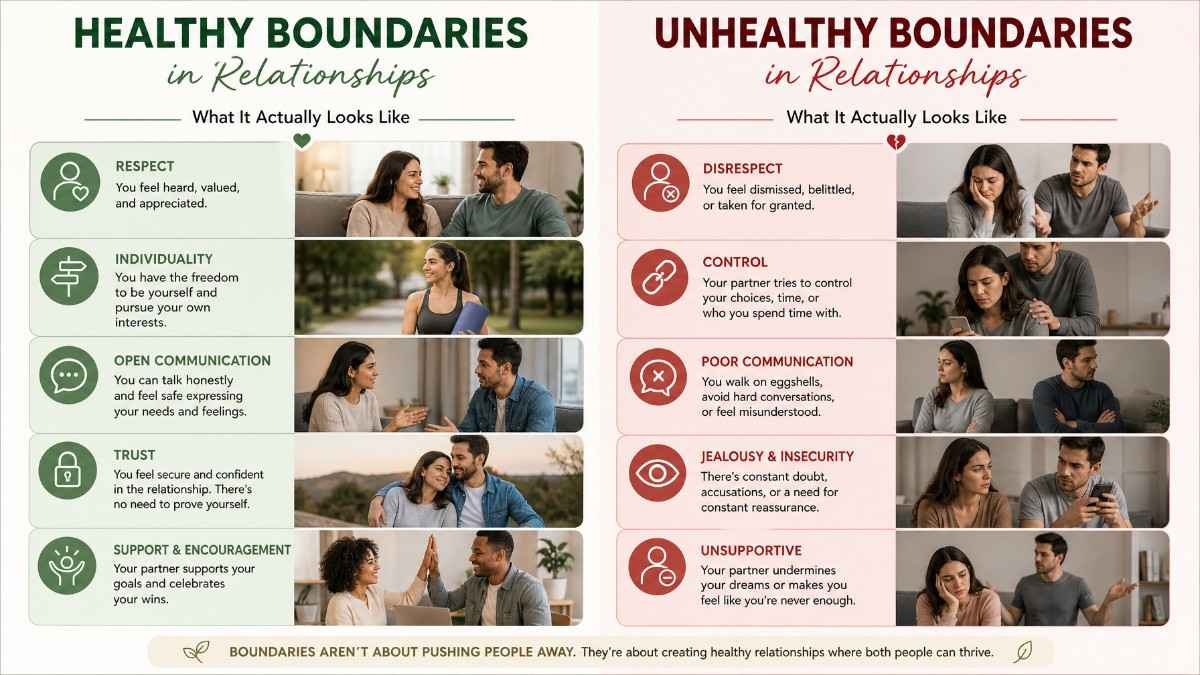
Save this. The remaining dimensions continue below.
Emotional source: rooted in self-respect versus rooted in fear
A limit that comes from self-respect sounds like this: I know what I need, and I am willing to ask for it. A limit that comes from fear sounds like this: I cannot bear to be in a situation where that thing might happen again, so I am going to make rules that prevent it. Both might look identical from the outside. Inside, one is a woman standing on solid ground. The other is a woman standing on anxiety with confidence branding.
You hold the limit calmly and consistently because it reflects what you genuinely need to feel respected. It does not fluctuate with how anxious you are feeling that week. It existed before the relationship and will exist after, because it comes from you, not from him.
The limit is directly traceable to something that hurt you before, either in this relationship or a previous one. You know it. He can probably feel it. The limit is doing the work of protecting a wound rather than establishing a genuine requirement, and wounds need healing, not rules.
Response to honoring: relief versus relief plus power
Pay attention to how it feels when your limit is honored. If it feels like relief and safety, that is the sign of a limit that was genuinely needed. If it feels like victory or vindication, something else is happening. A limit is not supposed to feel like winning. It is supposed to feel like being met, like being in a relationship where what you need is real and is treated as real, without drama and without negotiation.
He honors the limit and you feel settled. Grateful, maybe. Secure. The relationship feels safer. That is exactly what it was supposed to feel like. The limit did its job, and both of you are better positioned to be present with each other because of it.
He honors the limit and you feel something close to satisfaction, the feeling of a test passed, of leverage confirmed, of knowing you can produce compliance. That feeling is a signal. It is worth examining honestly before it becomes the shape of your entire relationship.