
A boundary lives on your side of the line. The moment it crosses over to theirs, it has become something else entirely.
At some point in almost every relationship where a woman starts holding herself to a higher standard, the question surfaces. She says what she needs. She names what she will not accept. She stops shrinking to make someone else comfortable. And then, from somewhere, comes the whisper: is this controlling? Am I asking too much? Is a limit the same thing as a leash?
It is worth sitting with that question honestly, because the answer matters and because the two things are genuinely different. A boundary is a decision about your own life. Control is a decision about someone else's. One protects your peace. The other manages their behavior. They sound similar in certain moments and feel similar when you are anxious and reaching for language, but they are not the same, and knowing the difference is what separates a woman who holds herself steady from a woman who is quietly trying to run someone she loves.
These twelve comparisons are not a judgment. They are a mirror. Read them the way you would read something a good friend put in front of you when you asked her to be honest with you.
Where the action lands: your life or theirs?
This is the clearest line between the two. A boundary describes what you will do. It does not describe what they must do. "If this continues, I will need to create some distance" is a boundary. "You are not allowed to do that" is control. The boundary lives entirely on your side and governs your behavior, your choices, your presence. Control reaches across and governs theirs. You can hold a boundary even if the other person refuses to cooperate, because the consequence lives with you. You cannot enforce control without their compliance. That distinction alone will answer most of your questions.
If the limit you are setting requires the other person to change, stop, or act differently before you can feel safe, it is worth examining whether you are protecting yourself or managing them.
What the consequence looks like: your withdrawal or their punishment?
Boundaries come with consequences that are natural extensions of your stated need. You said you needed honesty. He was not honest. You take space. The consequence flows from the limit. Control comes with consequences designed to hurt, pressure, or punish. The silent treatment that lasts three days. The cold withdrawal meant to produce guilt. The "fine, do whatever you want" that is absolutely not fine and both people know it. One consequence is you taking care of yourself. The other is you making him feel the cost of disappointing you. The first one is yours to carry. The second one is aimed at him.
Pay attention to what you are hoping the consequence will produce. If you are hoping it produces change in him, that hope is worth examining carefully.
Whether it requires their agreement or only your own
You do not need anyone's permission to set a boundary. You do not need to explain it until they understand, convince them it is reasonable, or wait for them to agree that your need is valid. A boundary is a unilateral decision about your own life. You decide what you will accept. You decide what you will do if it is not honored. Their agreement is not a prerequisite. Control, by contrast, requires their participation. It needs them to comply, adjust, or at minimum acknowledge the rule you are placing on them. It cannot function if they simply walk away from it. A boundary functions regardless of whether they stay or go.
If you are spending energy trying to get him to agree that your limit is fair, that energy is telling you something about whether you trust the limit yourself.
If you are trying to find the words for the conversation where these lines need to be drawn clearly, The Intimate Clarity Bundle has the exact language for it.
Get the BundleWhat the fear underneath it is protecting
Boundaries come from a desire for safety, integrity, and self-respect. The fear underneath a boundary is the fear of losing yourself, of tolerating something that costs you your dignity, of staying in a dynamic that quietly erodes you. Control comes from a different fear. The fear of losing him. The fear that if he has full freedom to choose, he will choose something other than you. The fear that love without management is love that might walk out the door. One fear protects something that belongs entirely to you. The other fear is trying to protect something that belongs to both of you, and that protection strategy almost always pushes away the very thing it is trying to hold.
Ask yourself what you are afraid of losing. The answer will tell you more than any checklist.
Whether it would hold even if you were not watching
A boundary holds because you hold it, not because he is under surveillance. You do not need to monitor his behavior to uphold your side of it. You simply notice whether the condition has been met and respond accordingly. Renata had been in a relationship for two years when she realized she had spent most of that time watching. Checking his phone when he was in the bathroom. Reading the names in his contacts with a sick, practiced casualness. Scanning his demeanor when he came home late. She had called this vigilance love for a long time before she recognized it as control wearing the costume of concern. The boundary would have looked different. It would have said: I need to be with someone I trust. If I cannot trust what I have here, I will leave. That limit does not require a surveillance apparatus. It requires a decision.
The version of a limit that requires no monitoring is the version that respects both of you.
Clarity delivered once a week, to your inbox.
One honest letter on love, patterns, and the conversations worth having. For women who are done settling for almost and done shrinking to keep the peace.
You are in.
Your first letter is on its way. Check your inbox.How it handles his freedom to make his own choices
A boundary does not restrict his freedom. It clarifies yours. He is entirely free to stay or go, to change or stay the same, to meet your need or not. The boundary simply describes what happens on your end if he does not. Control restricts his freedom. It says: you may not talk to her, you may not go there, you may not spend your time that way. It places a perimeter around his choices and assigns a penalty to stepping outside it. The problem with this is not only that it tends not to work. It is that a man who stays inside your perimeter out of fear or obligation is not actually choosing you. He is managing you. And a relationship built on management from both sides is not intimacy. It is a negotiated ceasefire.
If his love only looks like love because you have limited the conditions under which he can show you otherwise, that is worth sitting with honestly. The full guide to what boundaries in relationships actually protect starts there.
The six dimensions above give you the language for this distinction. The visual below puts both sides together so you can see them at a glance, and so you can be honest with yourself about which column describes the limits you have been setting and which column describes the limits you actually need.
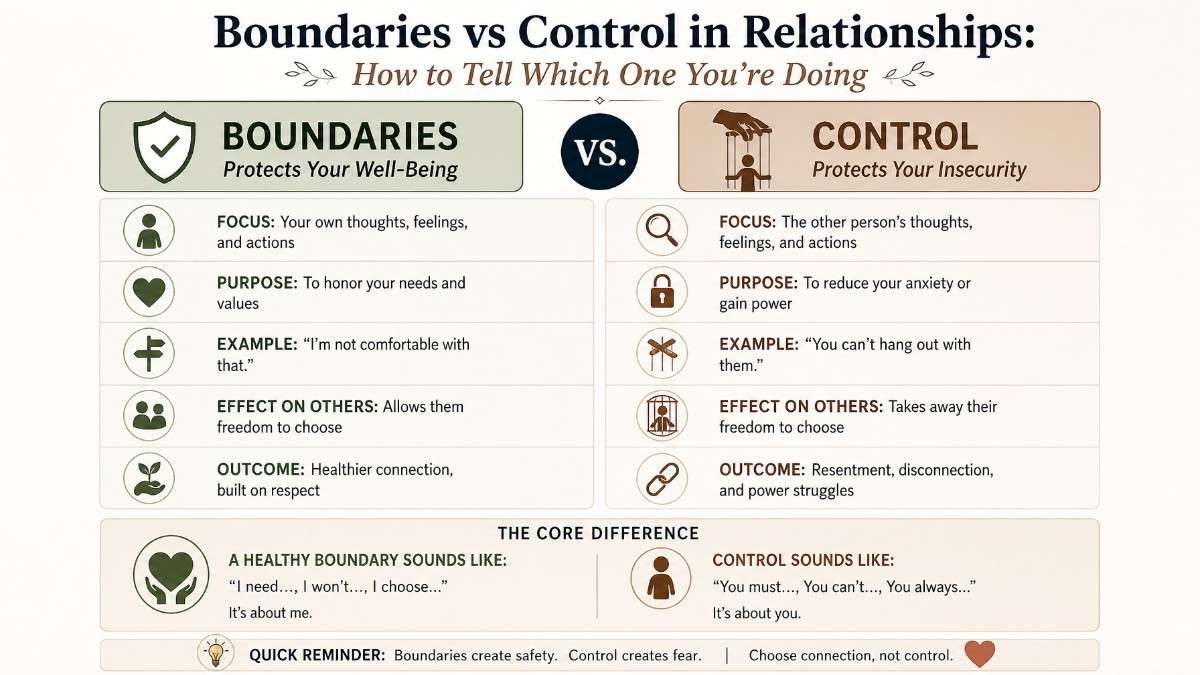
Save this if it is useful. The remaining six dimensions continue below.
What it asks of the relationship over time
Boundaries, over time, create clarity. They communicate who you are, what you require, and what kind of partnership you are willing to build. They are part of how a relationship becomes safe rather than uncertain. A relationship with clear limits held consistently tends to become more stable, not less. Control, over time, creates resentment. It produces a dynamic where one person feels managed and the other feels permanently anxious that the management is not working. It narrows the relationship rather than deepening it. It often produces exactly the behavior it was designed to prevent, because a person who feels controlled tends to pull away or push back. The very act of tightening the grip loosens the bond.
The question of whether your limits are making your relationship more honest or more tense over time will tell you a great deal about which side of this line you have been on.
If you are trying to hold a limit without it turning into a fight, The Intimate Clarity Bundle has the scripts that keep the conversation grounded.
Get the BundleWhether it is consistent or shifts depending on his behavior
A boundary is consistent because it describes something that is true about you regardless of his mood, his compliance, or how warm last night was. The limit does not shrink when he is sweet and expand when you are hurt. It is the same limit either way. Control tends to shift. The rules change depending on the emotional weather. What was forbidden last month is fine now because you are in a good period. What was fine last week is suddenly a betrayal because something else happened and the rules quietly recalibrated. This inconsistency is not always conscious. It usually reflects anxiety rather than manipulation. But it produces the same outcome: he never quite knows what the rules actually are, and neither do you, because they are not rules. They are moods wearing the costume of limits.
Understanding what healthy boundaries look like versus unhealthy ones comes down to this consistency more than almost anything else.
What it produces in you when it is honored
When a boundary is honored, what you feel is relief and safety. A settling of something that had been held tight. Not a rush of power, not a quiet satisfaction at having gotten your way, but a genuine easing. The thing that needed to be safe is safe. When control is complied with, what comes is something different. A brief sense of reassurance followed almost immediately by a new anxiety. Because control does not actually address the fear underneath it. He stopped talking to the person you were worried about, but you are still worried. He came home when he said he would, but you are still watching. Control produces compliance, not actual safety. It requires ongoing maintenance and produces ongoing vigilance.
If honoring the limit settled you, it was a boundary. If it only made you look for the next thing to worry about, it was probably something else.
Whether it would exist even if you were not afraid
The clearest test. Strip away the anxiety. Strip away the specific person and the specific history. Strip away the fear that this particular man might leave or lie or disappoint you. Does the limit still make sense? Would you hold it in any relationship, with any person, because it reflects something true about what you need to feel genuinely safe? A boundary passes this test. It exists because of who you are and what you require, not because of who he is and what you fear. Control usually does not pass this test. It exists in response to something specific: a betrayal, a pattern, an anxious attachment reaching for management because the alternative feels unbearable. Remove the fear and the need to control often removes itself with it. Remove the fear and the boundary remains standing.
This is what a toxic boundary pattern almost always reveals: a fear underneath that the limit itself cannot resolve.
How it sounds when you say it out loud
Language carries the distinction. A boundary sounds like: "I need honesty in my relationships. If I find out I have been lied to, I will not be able to continue." It is first-person. It describes your need and your response. Control sounds like: "You are not allowed to lie to me. If you do, you will lose me forever." It is second-person. It addresses his behavior and assigns a penalty. Both sentences describe the same value. Both arrive at the same consequence. But one is a self-statement and one is a rule imposed on another person. The difference in how they land is significant. Self-statements invite someone to meet you. Rules invite someone to comply or rebel. One builds intimacy. The other builds resentment, even when the relationship stays intact.
Knowing how to communicate a limit without it sounding like a demand is a skill that matters more than most women are told.
What it ultimately protects
A boundary protects you. Your peace, your dignity, your capacity to stay in a relationship without quietly disappearing from it. It protects the version of you that entered this with something intact and wants to leave it, if you leave it, still whole. Control tries to protect the relationship itself, usually by protecting it from him. It is an attempt to hold something together by removing the conditions under which it might fall apart. The irony is that the conditions control tries to remove, freedom, individuality, the right to choose, are the same conditions under which love actually becomes real. A love you manufactured by managing his behavior is not a love that belongs to you. It is a performance you directed. The version of this that actually lasts is the one where you held yourself steady and let him choose freely, and he chose you anyway.
That is what enforcing a boundary with dignity actually looks like when it is working correctly.