
There is a reason you cannot name what he is doing. He has built it so you cannot, because a thing without a name is a thing you cannot leave cleanly.
You came here because something is off and you do not have the word for it. He has not vanished exactly, but he has not stayed either. He replies, sometimes, just enough. He reacts to your story but never texts. He is technically present and completely absent at the same time, and the not-knowing is quietly driving you up the wall.
So let us name it, because naming it is the first thing that gives you your power back. There are three distinct things happening in modern dating that get blurred together, and they are not the same. Ghosting, soft ghosting, and breadcrumbing each leave you feeling slightly insane in a slightly different way, and each one is telling you something specific.
Once you can name which one you are in, you can stop debating yourself and start deciding. We will go through twelve clear differences, and by the end you will know exactly what he is doing. If you want the foundation, start with what ghosting in a relationship actually is, then come back and place him.
The basic definition of each
Ghosting is the full disappearance. He cuts contact completely and without explanation, and the silence is total. Soft ghosting is the slow fade with a polite mask, he still reacts to your stories or sends the occasional like, but never actually engages, so he can tell himself he never really left. Breadcrumbing is the most active of the three, he sends just enough attention, a flirty text here, a sweet message there, to keep you interested with no intention of going anywhere.
Ghosting is absence. Soft ghosting is the performance of presence with none of the substance. Breadcrumbing is intermittent feeding. Three different cruelties, same hollow center.
How much contact you actually get
This is the cleanest way to tell them apart. With ghosting, you get nothing, the line goes dead. With soft ghosting, you get the lowest possible signal of life, a reaction emoji, a viewed story, the digital equivalent of a wave from across a room he will never cross. With breadcrumbing, you get the most contact of the three, which is exactly what makes it so confusing, because the volume feels like interest.
More contact does not mean more care. Breadcrumbing hands you the most crumbs precisely because crumbs are cheaper than a meal.
What each one wants from you
Ghosting wants nothing from you anymore, the man has exited the building entirely. Soft ghosting wants to avoid the discomfort of a clean ending, so it keeps a thread attached to spare him the guilt of cutting it. Breadcrumbing wants something specific and ongoing, your attention, your validation, the ego boost of knowing you are still there, without ever paying the price of a real relationship.
The question that cuts through all three is simple. What is he actually willing to give me? With all of these, the honest answer is almost nothing.
The moment you can name what he is doing, you need the words to respond to it. The Intimate Clarity Bundle gives you the exact language for the man who keeps you in the gray area on purpose.
Get the BundleThe level of intention behind it
Ghosting can be impulsive, a panicked exit. Soft ghosting is often semi-conscious, a man drifting while telling himself he is being kind by not making it official. Breadcrumbing is the most deliberate of the three. It takes effort to dole out just enough attention to keep someone hooked, which means the breadcrumber is making active choices to keep you in orbit while giving you nothing real.
Be especially wary of breadcrumbing, because its intentionality is the tell. He is not confused. He is managing you.
How it makes you feel day to day
Ghosting produces a clean, brutal grief, it is awful, but it ends. Soft ghosting produces a low-grade confusion, a sense that you must be imagining the distance because he is technically still there. Breadcrumbing produces the worst of all, a chaotic hope, an emotional rollercoaster where every crumb spikes your optimism and every silence crashes it. It keeps your nervous system on a string.
If you feel addicted, anxious, and unable to relax, you are likely being breadcrumbed. The instability is not a bug, it is the entire mechanism.
Stop guessing what he is doing. Start naming it.
Every week, one honest letter on love, patterns, and the men who keep you in the gray. Written for women who would rather have clarity than a comfortable maybe.
You are in.
Your first letter is on its way. Check your inbox.Which one is hardest to walk away from
Ghosting, for all its cruelty, is the easiest to eventually leave, because there is nothing left to hold. Soft ghosting is stickier, the faint signal keeps you hoping. Breadcrumbing is by far the hardest to escape, because intermittent reward is the most addictive pattern there is. The unpredictability of when the next crumb arrives keeps you checking, waiting, and rationalising long past the point of sense.
If you cannot understand why you are still here when he gives you so little, that is the breadcrumb doing its job on your brain chemistry, not a flaw in you.
You have seen each of these three patterns on its own now, the clean disappearance, the slow fade, and the steady trickle of just enough. It helps to set them beside one another, because the differences are easiest to feel when you can see them in the same frame at the same time.
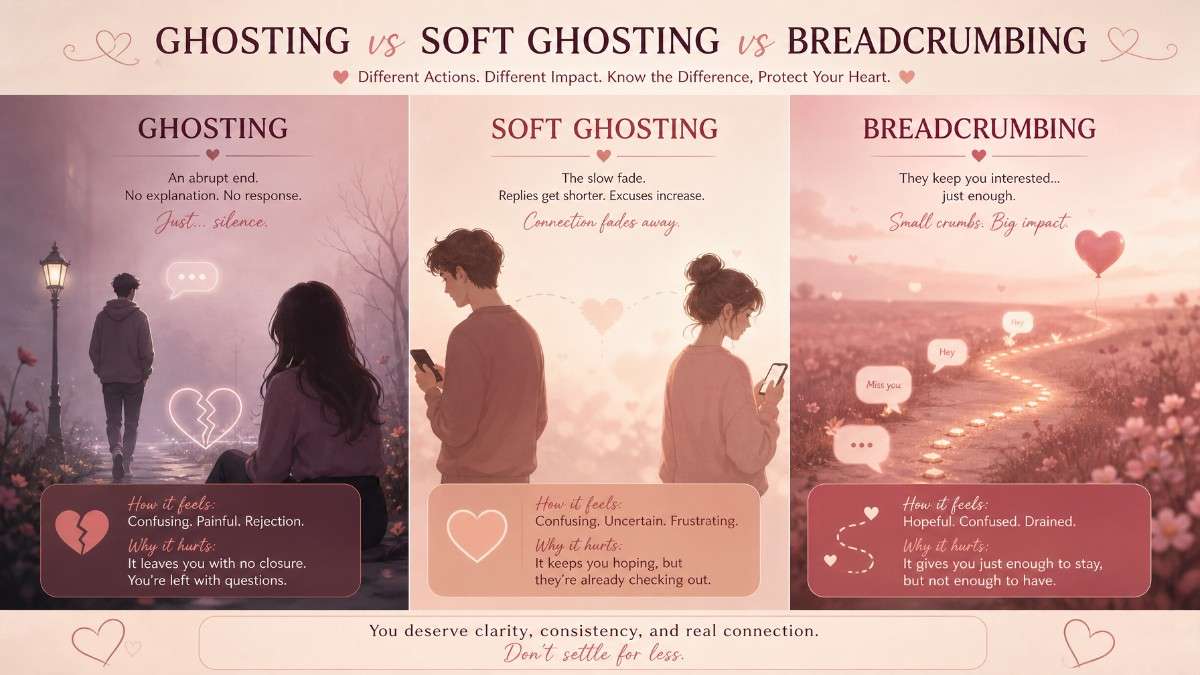
Notice your own body as you read across the three. The one that makes your chest tighten is usually the one you are living right now, and that recognition is the information you came here for.
What each one reveals about him
Take Priya, who spent months trying to decide whether the man she was seeing was a bad guy or a confused one. The naming helped. A ghoster reveals someone who cannot face hard conversations. A soft ghoster reveals someone conflict-avoidant enough to choose ambiguity over honesty. A breadcrumber reveals someone who values your attention but not you, comfortable keeping you on a hook for his own comfort. Once Priya saw he was breadcrumbing, the confusion lifted, because the behaviour finally had a name and a meaning.
Each pattern is a small confession of character. He is telling you who he is. Believe the pattern, not the crumbs.
Crumbs are easy to accept and hard to refuse without a script. The Intimate Clarity Bundle was written for the woman who is ready to stop feeding on almost and require the real thing.
Get the BundleHow long each one tends to last
Ghosting is usually a one-time event, a door slammed once. Soft ghosting tends to fade out over weeks, a connection thinning until it dissolves. Breadcrumbing can last indefinitely, months, even years, because it is designed to be sustainable. As long as he keeps feeding you just enough, and you keep accepting it, there is no natural endpoint. It only ends when you end it.
The fact that breadcrumbing can run forever is exactly why you cannot wait for it to resolve on its own. It will not. You are the only one who can call it.
The closure each one offers
Ghosting offers no words but a clear ending, the silence itself eventually becomes the closure. Soft ghosting offers neither words nor a clean ending, just a slow dissolve you have to declare over yourself. Breadcrumbing offers the cruelest non-closure of all, the door never closes, the crumb always implies more is possible, and you are left holding a hope that has no real future attached to it.
With all three, the closure is the same in the end. You give it to yourself, because none of these men are going to hand it to you.
How to respond to each one
For ghosting, the response is usually to let the silence be your answer and walk. For soft ghosting, the cleanest move is to name the fade and stop participating in the pretense of a connection. For breadcrumbing, the response has to be the firmest, you stop accepting crumbs entirely, because any engagement feeds the pattern and keeps it alive. Each one calls for a slightly different exit, but every exit is yours to take.
The good news is that you do not have to confront any of them to leave. You only have to stop responding to a connection that was never really there.
Why none of them is actually about your worth
Here is the part to tattoo on your memory. Ghosting, soft ghosting, and breadcrumbing are all strategies a man uses to manage his own comfort, fear, or ego. Not one of them is generated by a deficiency in you. The man who ghosts, fades, or feeds you crumbs is solving for himself at your expense. The behaviour is a mirror of his capacity, never a measurement of your value.
You can be magnificent and still get breadcrumbed by a man who is simply not built to give. The two facts have nothing to do with each other.
What all three have in common, and what to do now
Strip away the differences and they share one core truth. All three give you ambiguity instead of honesty, and all three ask you to accept far less than a real relationship while calling it something. That shared center is your answer. Whichever one he is doing, the prescription is the same, stop accepting ambiguity as a relationship and require clarity or leave.
Now that you can name it, you can act. If he has fully vanished, read the signs the ghosting is permanent. If he keeps drifting back, learn exactly what to do when he comes back after ghosting. To understand the wiring behind all three, read the psychology of why people ghost, and when you are ready to respond, here is how to respond to being ghosted without losing your dignity.