
A label does not create the difference. The difference is already there. The label just gives you permission to stop pretending you cannot feel it.
Most women who are trying to understand the situationship vs relationship question already know the answer in their body before they finish the sentence. They have been carrying the feeling for weeks, sometimes months, the low-grade unsettledness that lives just below the warmth, the quiet awareness that something is missing even when everything feels almost right. That feeling is the difference. It does not need a dictionary definition to be real. But naming it clearly helps you stop talking yourself out of what you already know.
The difference between a situationship and a relationship is not about how often you see each other, how good the chemistry is, or how emotionally deep the conversations go. All of those things can exist in a situationship. The one thing that cannot exist in a situationship, by definition, is the mutual agreement that you are choosing each other. That agreement is not a formality. It is the foundation. Without it, everything else, including the warmth and the closeness and the intimacy, is built on ground that can shift at any time without warning.
These twelve comparisons will show you exactly where the two things diverge, not in theory but in the daily felt experience of being in each one.
Security: knowing vs performing
In a real relationship, security is not something you have to manufacture or maintain. It travels with you. You leave his place after a fight and you still know, without having to remind yourself, that you are in a relationship and that this is one difficult moment inside something stable. The security is structural, built into the foundation of the thing, and it holds you even when things are uncomfortable.
In a situationship, the security exists only in the room. When you are with him, the warmth produces something that feels like security. You feel chosen, present, real. Then you leave, and the feeling does not come with you. It stays where it was generated. Two days later you are reading his last text again, trying to recover the certainty you felt when you were together. That recovery work is the most exhausting thing about a situationship, and it is also the clearest sign that what you have is not a relationship.
Definition: agreed vs assumed
In a real relationship, both people know what they are. Not because they have a framed document on the wall, but because at some point the question was asked and answered, even casually, even briefly. The definition was established and neither person has to wonder about it on an ordinary Tuesday afternoon.
In a situationship, the definition is assumed. You act as though you are in a relationship because the behavior resembles one. He acts as though the current arrangement is working because it is, for him. Neither person has said what this is, which means neither person has agreed to what it requires of them. That gap between assumed and agreed is where every situationship lives, and it is where most of the pain comes from too. The signs of a situationship almost always include this particular silence at the center.
Accountability: present vs absent
In a real relationship, both people are accountable to each other in ways they have agreed to, even implicitly. If he goes quiet for four days without explanation, you have standing to ask why. If he makes plans and cancels last minute repeatedly, you have standing to say that does not work for you. The relationship itself creates a framework of mutual accountability, because both people have signed on to it.
In a situationship, accountability is absent by design. He cannot be held to standards he has never agreed to. If he goes quiet for four days, he technically owes you nothing, because nothing was ever formally agreed. The absence of accountability is not cruelty. It is just the inevitable result of two people never having defined what they owe each other. Understanding this difference is part of knowing exactly what you are in before you decide what to do about it.
If any of these first three comparisons already feel familiar, The Intimate Clarity Bundle gives you the exact words to close the gap between what you have and what you actually need.
Get the BundleHow it sits next to other arrangements you might be comparing it to
Some women arrive at the situationship vs relationship question having already moved through other kinds of arrangements and trying to understand where this one fits. Casual dating is actually cleaner than a situationship in one important way: when two people agree to keep things casual, the terms are clear even if the commitment is low. The situationship is harder to navigate than casual dating precisely because nothing was ever agreed, which means neither person can point to what they actually signed up for.
An open relationship, for all its unconventionality, is also more defined than a situationship. Two people in an open relationship have had a real conversation about what they are doing and why. A platonic friendship between two people who care about each other is similarly clear: both people know where the line is. The situationship is uniquely painful because it sits between all of these, carrying the emotional investment of a romantic connection without the clarity that would make that investment feel safe. The difference between a situationship and a relationship is not a difference of depth or feeling. It is a difference of agreement. That one word is where everything else either holds or falls apart.
Effort: consistent vs conditional
In a real relationship, effort is consistent because both people have committed to showing up. Not perfectly and not identically, but with enough regularity that you can count on it. He initiates because he wants to be in contact with you, not only when the mood strikes. He makes plans because he wants to see you, not only when his schedule happens to open up.
In a situationship, effort tends to be conditional. It arrives in bursts, high enough to keep you invested, low enough that it never quite constitutes a commitment. The inconsistency is not always intentional, but it has a function: it keeps the investment asymmetrical in a way that benefits the person who wants less definition. You calibrate your effort to his, endlessly adjusting to wherever he happens to be that week, and you call it going with the flow because calling it what it actually is would require a conversation you are not sure you want to have.
The future: shared vs avoided
In a real relationship, the future is something both people feel comfortable referencing. Not necessarily in grand terms, not necessarily with timelines, but in the casual way that people who are planning to stay in each other's lives speak to each other. Next month. Next year. When we go there. When we do that. The future is a shared space you both feel entitled to inhabit.
In a situationship, the future gets avoided with a consistency that is hard to miss once you start noticing it. Plans stay short-term. References to next month get redirected. The future is implicitly off-limits because acknowledging it would require both people to name what they are building, and naming it would require a commitment that one or both people have not made. Serena described it once as being with someone who always spoke in the present tense, warm and engaged and fully there, but never once looking at anything past the end of the weekend.
You deserve to know exactly where you stand.
One honest letter a week on love, patterns, and the conversations that change things. For the woman who is done living in the in-between.
You are in.
Your first letter is on its way. Check your inbox.Identity: named vs unnamed
In a real relationship, you have a name in his world. Girlfriend. Partner. The person he is with. That name gets used when he introduces you, references you, or talks about you to the people in his life. It is a small thing that carries enormous weight, because being named is being claimed, and being claimed is being chosen.
In a situationship, you are unnamed. You exist in his life with a warmth that everyone around him can see, but without a title that makes you part of his official world. You are someone he sees. Someone he is talking to. Someone he is spending time with. The missing noun is not a coincidence. It is a deliberate gap that keeps him free of the obligations that a name would create.
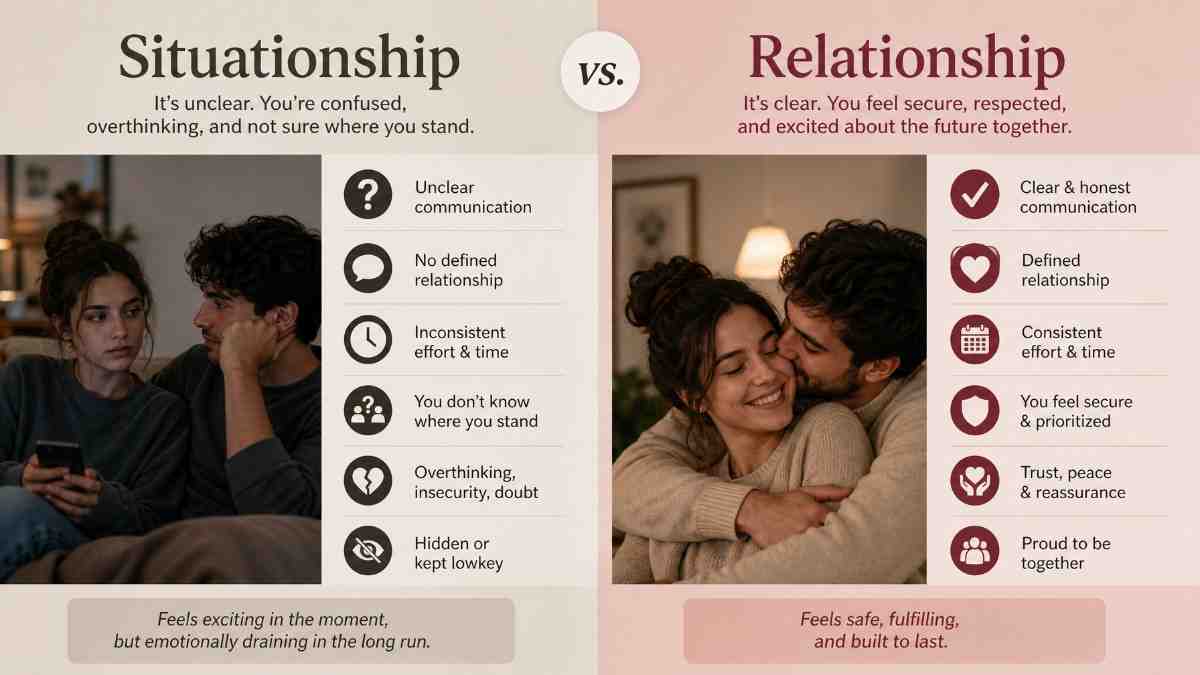
The twelve differences above come down to one underlying structure. The visual below maps where a situationship and a real relationship diverge across the areas that matter most.
Communication: free vs managed
In a real relationship, you communicate freely. Not without filters, not without tact, but without the constant background calculation of whether what you are about to say is too much, too soon, too serious, or too revealing of the fact that you actually care about this. The relationship creates a container for your full self, and your full self includes your feelings, your needs, and your opinions about how things are going.
In a situationship, communication is managed. You are always making decisions about what to say and what to hold back, calibrating your self-disclosure to his, keeping things light enough that nothing sounds like pressure. That management is exhausting in a way you often do not fully notice until you are out of the situation and realize how much mental energy was going into the editing every single day.
If points six and seven feel accurate to where you are right now, The Intimate Clarity Bundle gives you the exact language that removes the need to manage what you say.
Get the BundleIntegration: included vs compartmentalized
In a real relationship, you become part of each other's actual lives. You meet the people who matter to him. You appear in his stories. You are referenced in his world as a presence rather than kept in a separate compartment that his regular life does not touch.
In a situationship, compartmentalization is the default. You exist in a specific context with him, usually one-on-one, usually private, rarely overlapping with the broader architecture of his life. The compartment feels intimate because it is just the two of you in it. But intimacy inside a compartment is not the same as being genuinely included in someone's world, and the longer the compartment persists without expanding, the clearer it becomes that expanding it was never part of the plan.
Exclusivity: confirmed vs unspoken
In a real relationship, exclusivity is a conversation that happened. Both people know where they stand. Neither person is operating under an assumption they have never actually checked. The clarity of the agreement is part of what makes the relationship feel safe.
In a situationship, exclusivity is usually unspoken. You assume it because the alternative is too uncomfortable to sit with. He has never confirmed it because confirming it would mean acknowledging a level of commitment he has not agreed to. The silence around exclusivity is not neutral. It is one of the places where the situationship vs relationship difference is most practically significant, because unspoken exclusivity can dissolve at any time without technically breaking any agreement that was ever made. Knowing when to walk away from a situationship often starts with finally asking the question that has been avoided.
Reciprocity: balanced vs asymmetrical
In a real relationship, both people invest. Not identically, because people love differently, but proportionately enough that neither person feels like they are carrying the whole thing alone. There is a mutual quality to the effort that makes the relationship feel like a shared project rather than one person's ongoing campaign to be chosen.
In a situationship, the investment is almost always asymmetrical. One person wants more definition than the other. One person is carrying more hope. One person is doing more of the emotional labor of keeping the connection alive and interpreting its signals and managing its uncertainty. That asymmetry is not always obvious from the inside because the other person's warmth makes it easy to mistake their presence for their investment. But warmth and investment are different things, and the difference becomes very clear the moment one person asks for something more formal than the current arrangement.
Self-expression: full vs edited
In a real relationship, you can be the full version of yourself. Your needs, your moods, your opinions, your frustrations, the high-maintenance Tuesday and the insecure Thursday and the version of you that occasionally needs reassurance without having a specific reason. A relationship that is real is large enough to hold all of that without it being a problem.
In a situationship, you present an edited version. The lighter one. The one who is easy to be around and never asks for too much and seems perfectly fine with whatever level of contact he is offering that week. That editing, repeated over months, changes you in ways you do not fully notice until you are in a real relationship and realize how much space you actually take up when nobody requires you to make yourself smaller.
The core difference: chosen vs convenient
The deepest difference between a situationship and a relationship is this. In a relationship, you are chosen. Someone looked at all of who you are, the complexity and the need and the full-size version of you, and decided deliberately to be with you. That decision is what a relationship is. Everything else, the titles and the introductions and the confirmed exclusivity, are just the visible evidence of that decision having been made.
In a situationship, you are convenient. Not cruelly. Not consciously. But the arrangement works for the other person because you are there and you are warm and the cost of keeping you is low enough that there is no reason to change the terms. Being convenient is not the same as being chosen, and the distance between those two things is exactly the distance between the grief a situationship leaves and the safety a real relationship provides. You were always worth being chosen. The situationship just never required him to decide it.