
Healing rarely arrives as a moment you can point to. It arrives as a silence you did not fill, a text you did not refresh, a fear that came and went without running your whole day. If you are wondering, can anxious attachment become secure, these are the quiet signs worth noticing.
For the full foundation, read our complete guide to anxious attachment.
No one hands you a certificate when your nervous system starts to settle. The shift from anxious toward secure is quiet, gradual, and almost impossible to notice while it is happening, because you are looking for a dramatic before-and-after and what you get instead is a series of small moments where you simply reacted differently than you used to. The old pattern was loud. The healing is quiet, and quiet is easy to miss. If you still feel embarrassed by how strongly you once reacted, understanding why anxious attachment is not a flaw can help you hold that earlier version of yourself with more accuracy and less shame.
So you keep asking the question, the hopeful one underneath the doubt: can anxious attachment become secure, or is this just who I am now? The answer, supported by everything we understand about how attachment works, is yes. Attachment styles are learned, which means they can be relearned, and women move toward what researchers call earned security all the time. It is not a cure in the medical sense, because there was never a disease. It is a softening, a settling, a slow accumulation of evidence that closeness can be safe.
These are twelve signs the shift is already underway. Read them not as a test to pass but as a mirror held up to changes you may have been too close to see. If even a few of these feel familiar, the work is working, whether or not you have given yourself any credit for it.
Can anxious attachment become secure? A delayed reply no longer rewrites your day
There was a time when an unanswered text could hijack hours. You would check, recheck, draft and delete, and construct an entire story about what the silence meant, and the rest of your day would bend around the ache of not knowing. Notice if that has started to change. Notice if a slow reply now registers as a mild blip rather than an emergency, if you can see the unanswered message and simply go back to your life.
That is not indifference. That is regulation. The capacity to let a gap in contact be just a gap, rather than a verdict, is one of the earliest and clearest signs that the old alarm system is recalibrating. You still care. You have just stopped treating his response time as a measure of your worth.
You ask instead of assume
The anxious pattern is built on assumption. You read the silence, decode the tone, fill the blanks with the worst available interpretation, and then react to the story rather than the reality. A sign of growing security is that you have started to do the radical thing instead: you ask. You say, you seem a little distant today, is everything okay, and you let his actual answer replace the one you would have invented.
Asking requires a kind of courage the old pattern could not afford, because asking risks an answer you cannot control. When you find yourself choosing the direct question over the private spiral, you are demonstrating a trust, in him and in your own ability to handle the truth, that secure attachment is made of.
You can name the feeling before you act on it
The old reflex was instant: feel the panic, do something about the panic, send the text or pick the fight or go cold, all before any conscious thought could intervene. A sign of healing is the appearance of a small gap between the feeling and the action, a moment where you can say to yourself, I am feeling abandoned right now, this is the old fear, before you do anything about it.
That naming is everything. It is the difference between being run by the feeling and being aware of the feeling, and awareness is the doorway to every other choice. When you can label what is happening as it happens, you have already begun to loosen its grip.
If you are learning to name the feeling but still searching for what to do with it, The Intimate Clarity Bundle gives you the words to turn that awareness into a conversation.
Get the BundleHis mood is no longer your weather
For a long time, his emotional state set yours. If he was off, you were anxious. If he was distant, you were destabilized. Your inner climate was entirely at the mercy of his, and you had no thermostat of your own. A sign of growing security is that you can now notice he is in a mood without immediately absorbing it, without assuming it is about you, without needing to fix it before you can feel okay again.
This is differentiation, the ability to stay yourself while someone you love is having their own experience. You can be near his bad day without it becoming your bad day. That separateness is not coldness. It is the steady ground that lets you actually support him instead of drowning alongside him.
The silence stretches and you stay whole
Maya used to measure her relationships in response times. A few hours of quiet from the man she was seeing and she would feel herself coming apart, certain the silence meant the end. The turning point, when she finally noticed it, was undramatic. He went quiet for most of a day, and she realized in the evening that she had barely thought about it. She had been at work, with friends, inside her own life, and the silence had simply not had the power over her it once held.
That is the sign in its purest form. Not that the silence stopped happening, but that it stopped being able to dismantle you. When you can sit inside an uncertain gap and remain a whole person, with your own day and your own steadiness intact, the deepest part of the old pattern has begun to heal.
The shift toward secure happens one quiet choice at a time.
Every week, one honest letter on love, patterns, and the conversations worth having. Written for the woman who is becoming the steady person she once needed.
You are in.
Your first letter is on its way. Check your inbox.You can tolerate not knowing
The anxious mind hates an open question. Where is this going, does he still feel the same, what did that comment mean, the not-knowing itself feels unbearable, and the old pattern would do anything to resolve it, even resolve it badly, just to escape the limbo. A sign of growing security is a rising tolerance for uncertainty, an ability to let a question stay open without needing to force an answer that is not ready yet.
Real relationships contain a great deal of not-knowing, and security is largely the capacity to hold that ambiguity without panic. When you notice you can let things be unresolved for a while, trusting that clarity will come in time, you are exercising a muscle the anxious pattern never had access to.
Security rarely announces itself with one dramatic breakthrough. More often, it slips into the ordinary moments that used to steal your peace: the phone stays quiet for an hour, a question remains open until tomorrow, or you say what you need without rehearsing a softer version first. This small map helps you notice the shifts that are easy to miss while they are happening.
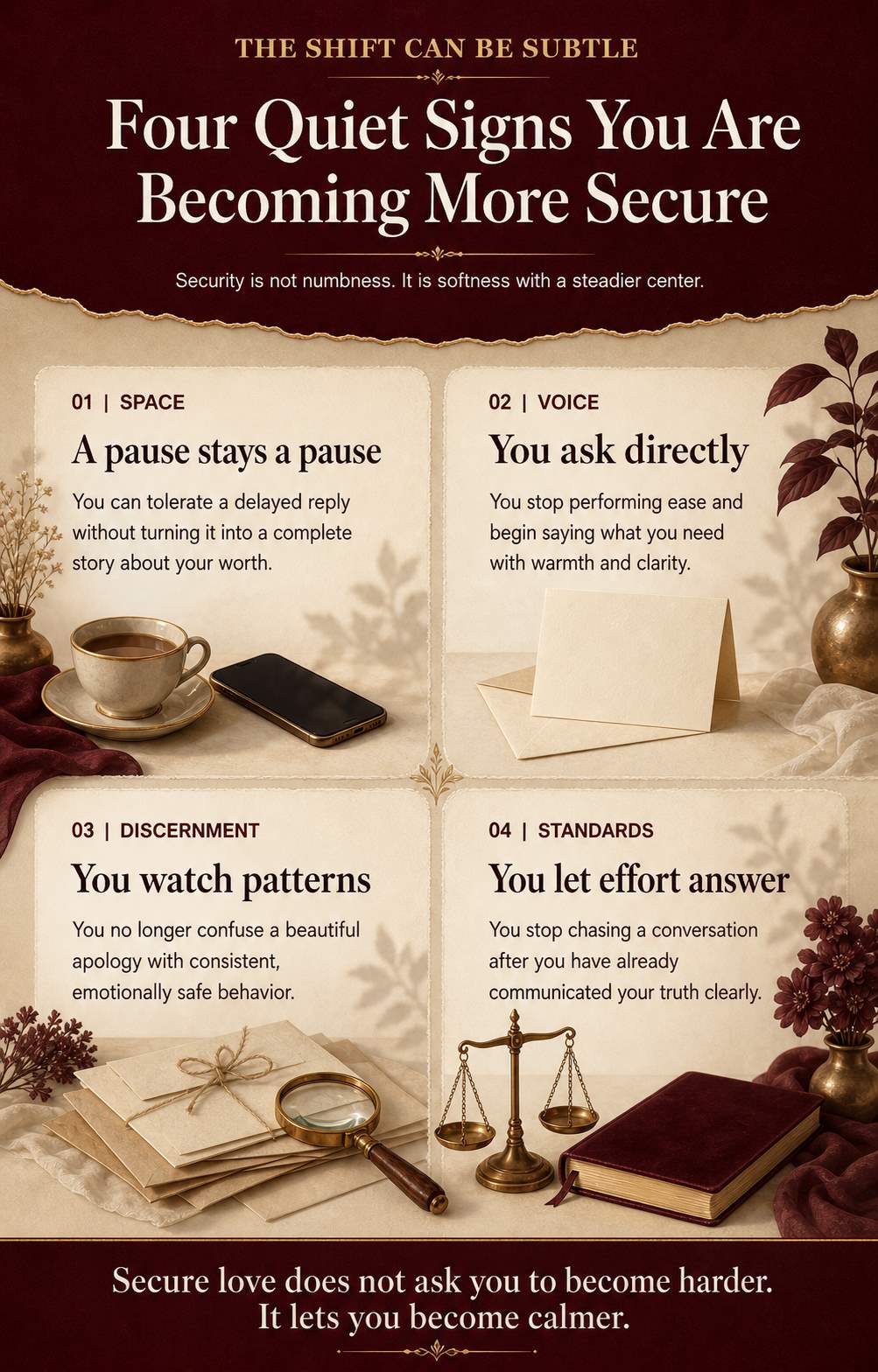
You stopped auditioning
There was a version of you that performed in relationships, who curated herself into the most easygoing, least demanding, most effortlessly lovable version she could manage, all to secure a love she did not believe she could keep as her actual self. A sign of healing is that the auditioning has quieted. You say the true thing instead of the strategic thing. You let him see your real reactions instead of the edited ones. The shift becomes easier when you have already made room for what anxious attachment actually needs to hear, because directness feels less frightening when you stop treating your needs as an inconvenience.
This matters more than it might seem, because the auditioning was always built on the belief that the real you was not enough. When you stop performing, you are acting on a new and truer belief: that you are lovable as you actually are, and that a love requiring constant performance was never going to be the love you wanted anyway.
If you have stopped auditioning but still reach for the old scripts under pressure, The Intimate Clarity Bundle holds the words for showing up as your real self in the moments that matter.
Get the BundleA small rupture no longer feels like the end
A disagreement, a moment of distance, a misunderstanding, the old pattern treated every one of these as a potential ending, a crack that might widen into abandonment at any second. A sign of growing security is that small ruptures now register as what they are: normal, survivable, often even useful moments in a relationship that can absorb them. You can have a hard conversation without being certain it is the last one.
Secure attachment is not the absence of conflict. It is the confidence that conflict can be repaired, that a relationship is strong enough to hold disagreement without shattering. When a rough patch stops sending you into a tailspin and starts feeling like something the two of you can work through, the ground beneath you has genuinely shifted.
You can be apart without unraveling
Time apart used to feel like a small abandonment. A weekend where he was busy, a stretch where the contact thinned, and the anxiety would climb. A sign of healing is that you can now have your own separate life, your own absorbing world, without experiencing distance as a threat. You can miss him in a warm way rather than a panicked one, and you can fill your own time with things that are genuinely yours.
This is one of the most freeing markers of all, because it returns your life to you. The relationship becomes a rich part of a full existence rather than the entire structure your wellbeing depends on. A woman who can be happily apart is a woman who chooses the relationship freely, rather than clinging to it out of fear.
You state a need without rehearsing it for an hour
The old way of asking for something involved an enormous amount of preparation. You would script the request, soften it, time it for the right moment, run through his possible reactions, all to manage the terror that asking for anything might cost you the relationship. A sign of growing security is that you can now name a need relatively plainly, in something close to real time, without the elaborate choreography of fear.
I would like to see you more this week. I felt hurt by that, can we talk about it. When these sentences start to come out without an hour of internal rehearsal, you are demonstrating a trust that your needs are legitimate and that the relationship can hold them. That ease is not something the anxious pattern could ever produce.
You notice the spiral start and step out of it
You will probably always feel the first flicker of the old fear. Healing does not mean the trigger disappears. It means that when the spiral begins, you can recognize it for what it is and choose not to follow it all the way down. You feel the pull to check his location, to send the third text, to manufacture a reason to make contact, and you notice the pull without obeying it.
This is the practical heart of the difference between an anxious pattern and the anxiety itself. The feeling visits, and you let it pass through without acting on it, and each time you do, you teach your nervous system that the panic does not require obedience. Catching the spiral and stepping out of it is not a sign you have failed to heal. It is the healing, in motion.
Reassurance is welcome but no longer required
Here is the marker that tells you how far you have come. There was a time when reassurance was oxygen, when you needed to hear that he loved you, that you were okay, that nothing was wrong, just to make it through the hour. A sign of earned security is that reassurance has become something you enjoy rather than something you depend on. It is lovely when it comes. You no longer come apart when it does not.
That shift, from needing reassurance to merely appreciating it, is the quiet summit of this whole process. It means the safety has moved inside you, that you carry a steadiness that no longer has to be supplied from the outside moment to moment. You are becoming the secure base you always needed, and from that ground, you finally get to experience what love feels like when it is not braided with fear. The woman who once needed constant proof is learning to rest in a love she simply trusts.