
The difference is not whether the fear feels real. Both kinds of anxiety can tighten your chest and interrupt an otherwise ordinary day. The difference is where the fear keeps returning when the room becomes quiet again.
For the full foundation, read our complete guide to anxious attachment.
A woman can look composed from the outside and still feel her entire evening tilt because a man who usually texts after work has gone quiet. She rinses the same wineglass twice, sets it beside the sink, and tells herself she is being ridiculous. Ten minutes later, her phone is face down on the counter because looking at it feels embarrassing, but not looking at it feels worse.
That experience is often called anxiety as though the label settles the matter. Sometimes it does not. Anxious attachment and a broader anxiety condition can overlap, but they are not interchangeable. One gathers around closeness, especially when affection feels uncertain. The other can follow a woman into work, sleep, money, family worries, errands, and quiet Sunday mornings when her relationship is not the problem at all.
I saw the difference clearly while listening to Melissa describe the week she finally stopped calling every anxious feeling the same thing. Her relationship with Daniel had been steady for almost a year. He was affectionate, consistent, and usually easy to read. Still, when his replies slowed during a demanding week at work, Melissa felt the old alarm return. At the same time, she was lying awake worrying about a presentation, her mother's upcoming appointment, and whether the unfamiliar sound from her car meant a repair she could not comfortably afford. The feelings lived in the same body, but they did not move through her life in the same way.
This comparison is a reflection tool, not a diagnosis. If worry is persistent, difficult to control, or interfering with daily life, a qualified health care professional is the right person to speak with. The purpose here is gentler and more practical: to help you notice the shape of the fear before you decide what kind of support it needs.
Anxious attachment waits beside the phone; regular anxiety may be waiting before the phone rings
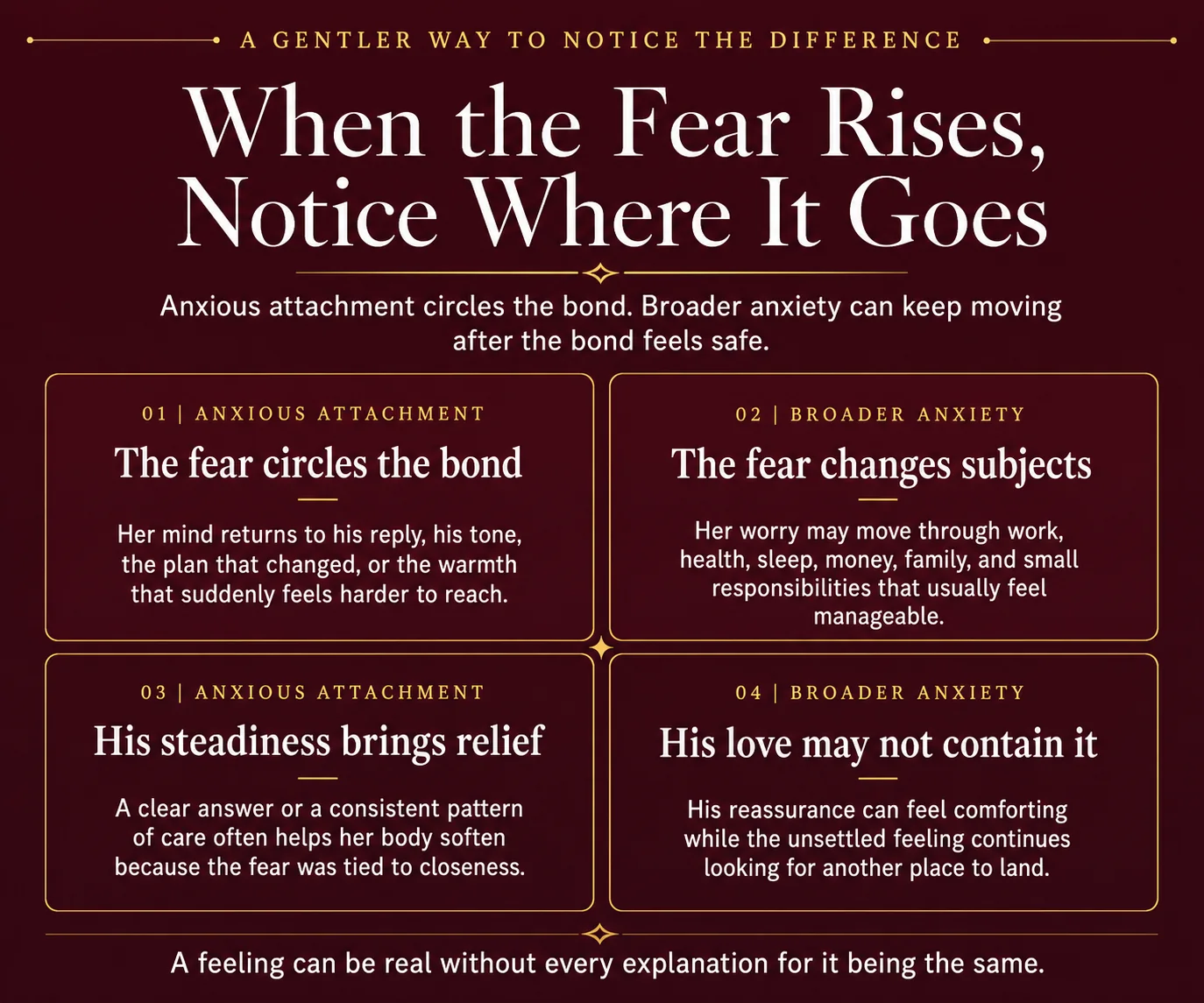
With anxious attachment, the body often reacts to a relational change. He usually sends a good morning message, and today he has not. You tell yourself he may be busy, but your attention keeps drifting back to the blank screen. The unease has an address. It is tied to the person whose warmth suddenly feels less available.
A broader form of anxiety may already be present before anything changes between you. You can wake with a tight jaw and a restless mind while the relationship feels perfectly loving. The worry simply looks for somewhere to land. One fear is stirred by uncertainty in closeness. The other can arrive carrying its own weather.
Anxious attachment studies his tone; regular anxiety studies the whole day
Attachment anxiety can make a woman exquisitely sensitive to small changes in emotional temperature. A shorter reply, an affectionate name that disappears from one message, or a plan that sounds less definite than it did yesterday can become evidence she turns over in her mind until the edges are worn smooth. She is not inventing the change. She is struggling to understand what the change means.
Broader anxiety is less selective. It can move from the unread email in her inbox to a headache, then to a bill she has already paid, then to the possibility that she forgot something important. The concern changes costumes while the unease remains. When the mind scans the whole day rather than one relationship, the support may need to reach further than a conversation with a partner. If your worry keeps returning to closeness, the private signs in Do I Have Anxious Attachment? can help you notice whether the relationship is carrying most of the alarm.
Anxious attachment often has a relational cue; regular anxiety may not offer a clean beginning
Melissa could usually trace the sharpest relationship spirals back to a moment. Daniel would say, "I will call you later," and later would quietly become tomorrow. The click of the bedside lamp made the apartment feel lonelier than it had five minutes earlier. Her thoughts immediately narrowed around the unanswered question: had something changed between them?
Her other anxiety was harder to locate. On some mornings, it arrived before breakfast as a faint dread beneath her ribs. Daniel could be attentive, work could be going well, and nothing obvious could be wrong. She still felt as if she had missed an appointment with a disaster she could not name. A relational cue points toward attachment activation. Anxiety that regularly arrives without one deserves a wider lens.
If a change in closeness makes every sentence disappear from your mind, The Intimate Clarity Bundle gives you words that sound calm without asking you to pretend you feel nothing.
Get the BundleAnxious attachment wants reassurance from him; regular anxiety may remain after he reassures you
When attachment fear rises, a warm response from the person you love can bring noticeable relief. His message arrives, the explanation is reasonable, and your shoulders lower before you have even finished reading. The relief may not last forever, especially if the underlying pattern is still tender, but the body recognizes the reassurance it was reaching for.
A broader anxiety condition does not always soften in the same way. His voice may comfort you, but the worry can move to tomorrow's meeting or the strange ache near your shoulder blade before the call is over. His affection is welcome, yet it cannot settle a fear that was never entirely about him.
Anxious attachment can make distance feel personal; regular anxiety can make ordinary uncertainty feel dangerous
When a woman is activated by anxious attachment, distance rarely feels neutral. A quiet afternoon can begin to feel like a verdict. She may understand intellectually that a man can be occupied, tired, or absorbed in his own responsibilities, but her body reads the pause as a possible withdrawal of love. The pain is not simply that he is unavailable for a few hours. The pain is what his unavailability seems to imply.
Broader anxiety can attach that same sense of danger to ordinary uncertainty outside romance. A routine email from a manager may feel ominous before it is opened. A small household repair can swell into a chain of imagined consequences. The subject is different, but the nervous system still behaves as if uncertainty is something she must solve immediately.
It was never just in your head.
Every week, one honest letter on love, patterns, and the conversations worth having. Written for women who want clarity without being told to simply calm down.
You are in.
Your first letter is on its way. Check your inbox.Anxious attachment may quiet when the relationship feels secure; regular anxiety can follow you into a secure relationship
A steady relationship can reveal a great deal. When a man is clear, responsive, and emotionally present, attachment fear often begins to soften over time. The woman who used to reread every message slowly discovers that she can leave her phone in another room and finish making dinner. The change is gradual, almost shy, but she can feel it.
Broader anxiety can remain even when love is safe. Melissa noticed this after Daniel's busy week ended. They spent Saturday morning at a small cafe, his hand resting lightly over hers while rain moved down the window. Nothing between them felt uncertain. She was still worrying about the presentation waiting for her on Monday. The relationship had settled. Her nervous system had not.
The experiences can overlap, but they do not ask the same questions. Anxious attachment keeps looking toward the bond. Broader anxiety can keep moving after the bond feels safe.
Anxious attachment is shaped by how you experience closeness; regular anxiety can affect how you experience daily life
Anxious attachment lives most visibly in intimate relationships. It can make affection feel precious and precarious at the same time. You enjoy the tenderness, yet part of you remains alert for the moment it might disappear. Even love can feel difficult to receive when you are standing guard over it.
Broader anxiety can affect the rhythm of daily life more widely. It may interrupt concentration, sleep, rest, or the ability to enjoy an ordinary afternoon without mentally rehearsing what could go wrong. When worry repeatedly reaches beyond romance, it deserves to be understood beyond romance too.
If your fear is relational and you are tired of speaking only after the spiral has chosen the words for you, The Intimate Clarity Bundle helps you begin the conversation from a steadier place.
Get the BundleAnxious attachment can tempt you to seek proof; regular anxiety can tempt you to seek certainty everywhere
Attachment fear often creates a quiet hunger for proof. You notice who initiated the last conversation, how long the reply took, and whether his affection feels as generous as it did last month. The mind begins gathering evidence because the heart does not feel safe enough to rest. That vigilance can exhaust the very softness you want to bring into love.
Broader anxiety often seeks certainty across a larger field. It wants every appointment confirmed, every symptom explained, and every possible outcome accounted for before the day can feel manageable. Neither pattern is a moral failure. Both become costly when a woman spends more time monitoring her life than living inside it. Sometimes the cost is easiest to recognize through the things anxious attachment quietly makes you do while you are trying to feel safe again.
Anxious attachment is an attachment style; an anxiety disorder is a clinical condition
Anxious attachment is a way of relating in close relationships. It can be painful and disruptive, but it is not the same thing as a mental illness. Calling it a character flaw adds shame. Calling it a clinical diagnosis adds confusion. A more accurate name gives you room to notice how you respond when closeness feels uncertain.
An anxiety disorder belongs in a different category. When worry is persistent, difficult to control, and interfering with daily life, it deserves proper assessment from a qualified professional. Treating every fear as attachment can be just as limiting as treating every attachment wound as ordinary overthinking.
Anxious attachment needs relational honesty; regular anxiety may need professional care
When the pain is relational, honesty matters. A woman needs to notice whether the man in front of her is actually consistent, whether the relationship has enough clarity to rest inside, and whether she is asking him to answer for an old wound he did not create. Standards and self awareness belong in the same room. That is also why what anxious attachment actually needs to hear matters: reassurance is useful only when it sits beside clarity and consistent behavior.
When worry is spreading across daily life, professional support may be the more loving next step. That is not an admission that the fear is imaginary. It is a refusal to keep improvising care for something that is affecting your peace, your sleep, or your ability to move through an ordinary day.
Anxious attachment can soften through earned security; regular anxiety should not be left for romance to solve
Earned security often arrives quietly. It can look like noticing the urge to send a second message and deciding to finish your shower first. It can sound like asking a direct question instead of performing indifference. You can read more about the quiet signs of becoming secure when you want to see how subtle that change can be.
A loving partner can support you, but he cannot become the entire treatment plan for a wider anxiety condition. Romance is allowed to be tender without being asked to carry work that belongs with a health care professional. Love becomes safer when it is no longer responsible for holding up the whole sky.
The two feelings can coexist, but clarity changes what you ask of yourself and of love
Melissa did not arrive at a neat little answer by the end of that week. She arrived at something more useful. When Daniel's communication changed, she stopped scolding herself for wanting clarity and asked him directly what was happening. He explained the pressure he had been under, apologized for going quiet, and became more intentional about telling her when work was likely to swallow an evening. His steadiness gave her relationship fear somewhere softer to land.
She also stopped expecting his reassuring voice to settle every other worry moving through her life. She made an appointment with a professional because the sleeplessness and constant scanning deserved care of their own. That distinction gave the relationship room to breathe. It also gave Melissa a way to meet herself with more accuracy and less shame.
You do not need to force every anxious feeling into one explanation. You need to notice whether the fear keeps circling the bond, whether it keeps traveling after the bond feels safe, and whether it is time to ask for support that fits the life you are actually living. That same discernment will help you recognize the difference between attachment fear and genuine love without making yourself smaller to earn either one.