
You did not come here for a label. You came here because something in the way you love has been quietly exhausting you, and you finally want to know what to call it.
Have you ever sat with your phone in your hand, perfectly composed on the outside, while inside you were running a calculation no one could see? How long has it been. Is this normal. Did I say something. Should I wait, or would waiting make it worse. You looked, to anyone watching, like a woman simply checking her messages. You were actually doing the quiet, full-time work of trying to keep love from leaving the room.
If that is familiar, you are in the right place, and I want to be careful with you here. This is not a quiz that scores you and files you into a box. There is no number at the bottom that decides your worth. These are twelve honest questions, and they are meant to be a mirror, not a verdict. Read each one slowly. Notice which ones make something tighten in your chest before you have even finished the sentence, because that tightening is usually the most honest answer you have.
Do I have anxious attachment? Start with the delayed reply
Ask yourself honestly what happens inside you when someone you care about goes quiet for a few hours. Does it sit lightly, the way it would for a woman who assumes the best? Or does it move in and rearrange the furniture, pulling your attention away from your work, your friends, the life that was perfectly fine an hour ago? How do you know if you have anxious attachment? One of the clearest places to look is right here, in how much power a small silence has over your inner weather.
If a few unanswered hours can quietly hollow out an afternoon, that is worth noticing without judgment. It is information about how much of your peace currently lives in someone else's hands.
Do you feel calm in love, or only briefly relieved?
Think about the good moments with someone you are drawn to. When he is warm, when he reassures you, when everything is going well, what does that feel like? For a securely attached woman it feels like calm, a steady baseline she can rest in. For an anxiously attached woman it often feels like relief, which is different, because relief is what you feel when a threat lifts, and a threat that can lift can always return.
If your happiest moments in love are colored by the quiet knowledge that they could be taken away, you have been living closer to the edge than you deserve to. It may help to read about the difference between anxious attachment and genuine love, because calm can feel unfamiliar when relief has been mistaken for romance.
Do you reach for reassurance and then feel ashamed for needing it?
There is a particular loop that many women with anxious attachment issues know intimately. You feel the need for reassurance rise, you ask for it in some small way, and the moment you do, a wave of embarrassment follows. You scold yourself for being needy. You wish you could be the kind of woman who does not require this. The need and the shame arrive together, so tangled you can barely tell them apart.
That shame is not a sign that your needs are too big. It is a sign you were taught, somewhere along the way, that your needs were an inconvenience to be managed rather than a part of you to be met. This is why what anxious attachment actually needs to hear begins with reassurance that has substance behind it.
If the first few of these already feel like reading your own mind, The Intimate Clarity Bundle gives you the words to ask for what you need without the shame folded in.
Get the BundleDo you find the available men a little boring?
This is an uncomfortable one, so sit with it gently. When a kind, consistent, genuinely available man shows interest, what is your honest reaction? Is there a spark, or is there a faint, almost guilty flatness, a sense that something is missing? And when an inconsistent man keeps you slightly uncertain, does that uncertainty light you up in a way you have learned to call chemistry?
If the men who could actually love you well leave you cold while the ones who keep you guessing feel like fate, that is not your taste. That is your wound choosing for you.
Do you read meaning into the smallest changes?
A slightly shorter text. A period where there used to be none. A tone that feels a quarter-degree cooler than yesterday. Do these register for you as ordinary fluctuations in a busy person's day, or do they land as evidence, little data points you collect and analyze and lose sleep over? The anxiously attached mind is a brilliant detective working a case that, most of the time, does not exist.
All that decoding feels like care, and it even feels like intelligence, but it keeps you in a state of low alarm that the people you love rarely even know you are in. You may recognize more of that private rhythm in the things anxious attachment quietly makes you do while you are trying to feel safe.
For the woman who is ready to stop decoding and start asking.
Every week, one honest letter on love, patterns, and the conversations worth having. Written for women who feel everything deeply and are learning to trust what they feel.
You are in.
Your first letter is on its way. Check your inbox.Do you make yourself smaller to keep someone close?
Notice whether you have a habit of editing yourself down around the people you are afraid to lose. Do you swallow the thing you wanted to say? Do you call yourself easy-going when you are actually quietly disappointed? Do you present a version of yourself with fewer needs and lighter feelings than the woman who actually lives inside you, because some part of you believes the smaller version is safer to love?
A woman who keeps shrinking to fit the space she is given eventually forgets her own real dimensions, and that forgetting is one of the highest prices this pattern quietly charges.
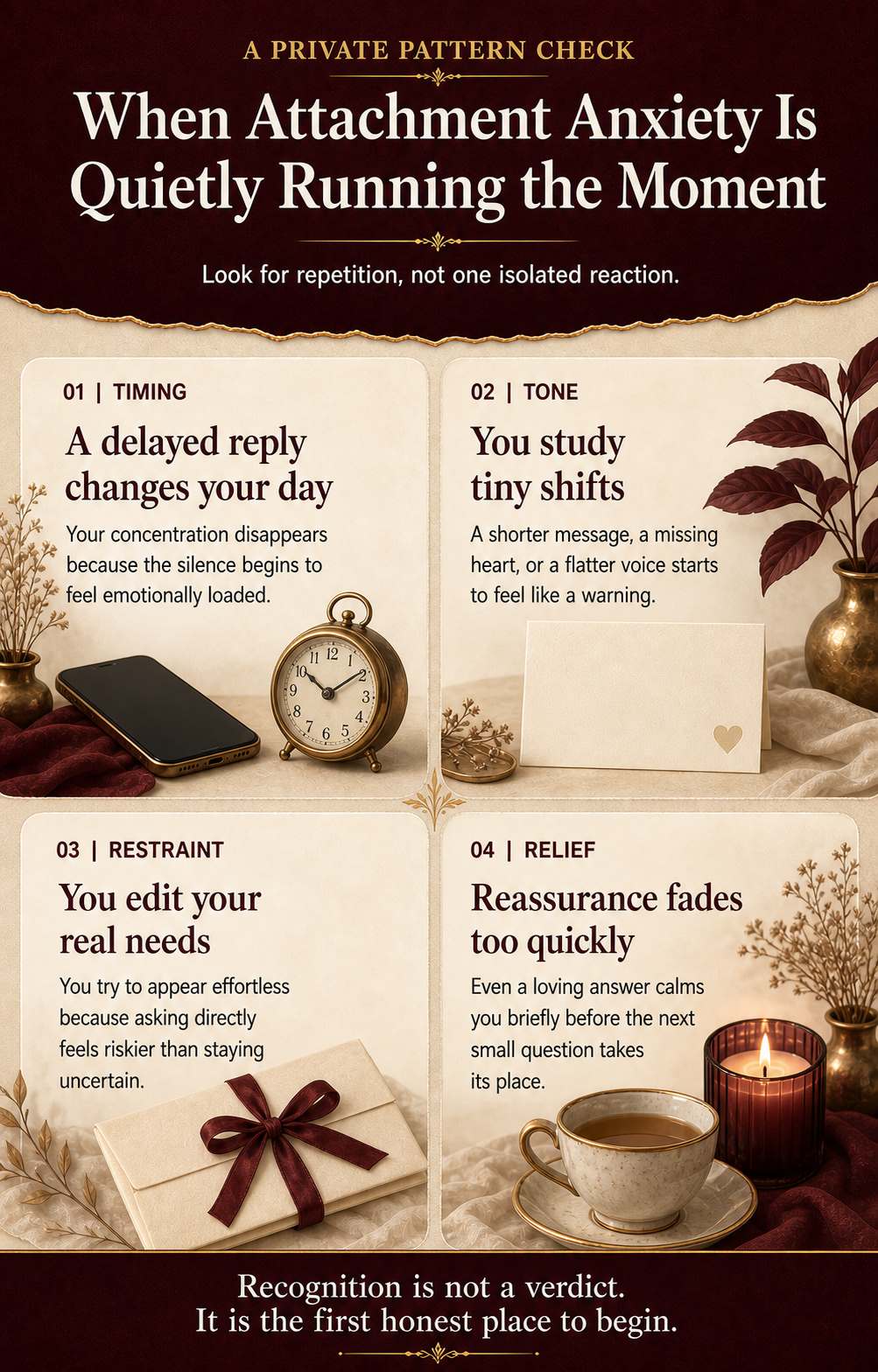
One difficult day does not define your attachment style. The pattern becomes clearer when the same private reactions return again and again: the delayed reply that changes the texture of your afternoon, the tiny shift in tone you cannot stop studying, or the reassurance that calms you only briefly before another question rises. This visual gives you a softer way to notice the repetition without turning recognition into a verdict.
Does the fear of being left ever make you leave first?
Here is a subtle one. When you sense that someone might be pulling away, do you ever beat them to it? Do you withdraw your warmth, pick the small fight, or quietly start the goodbye in your own mind long before there is any real reason to? The fear of abandonment does not always look like clinging. Sometimes it looks like the woman who walks out of the room so she does not have to watch anyone else leave it.
Leaving first feels like protection, but all it really protects is the fear, while it quietly costs you the relationships that might actually have stayed.
If you are recognizing yourself in more than a few of these, The Intimate Clarity Bundle was written for exactly the conversations this pattern has made you afraid to have.
Get the BundleDo you confuse intensity with love?
Think about the relationships that consumed you most. Were they the steady, nourishing ones, or were they the turbulent ones, full of highs and lows, where the relief of his return after distance felt like the most intense love you had ever known? It is worth asking honestly whether what you have been calling great love was sometimes just a great deal of activation, a nervous system being rewarded just often enough to keep reaching for the lever.
When intensity becomes your measure of love, the calm and available men will always feel like settling, and you will keep mistaking the ones who hurt you for the ones who move you.
Is it hard to believe someone when they say they care?
When a man tells you he cares about you, can you take it in and let it settle, or does a quiet voice immediately begin to argue with it? Does he really, or is he just saying it. For how long. What if he changes his mind. The reassurance lands, but it does not stay, because the part of you receiving it does not yet trust that anything good will be allowed to remain.
If kind words slide off you like water, that is not because you are pessimistic. It is because somewhere you learned that good things were temporary, and your heart has been bracing ever since.
Do you ever feel like you care more than the other person does?
Notice if there is a recurring sense, across different relationships, that you are the one holding the rope a little tighter, investing a little more, feeling a little deeper. It can become so familiar that you stop questioning it, simply assuming that this is your role, to be the one who loves harder and waits longer and hopes more than the person across from you.
Sometimes that imbalance is real and the other person truly is offering less. But sometimes it is the pattern choosing partners who confirm the oldest story you carry, the one that says you will always have to do the loving for two.
Has someone close to you told you that you worry too much in love?
The people who know you well are often a clearer mirror than your own anxious mind. Have your friends, gently or otherwise, pointed out that you spiral over things that seem small to them? Have they watched you lose a weekend to a man's silence and wondered why someone so capable becomes so undone by a delayed reply? Their confusion is not unkindness. It is the gap between how love feels for them and how it feels for you.
If the people who love you keep noticing the same thing, it might be worth letting their view in, not as criticism, but as evidence that the way you have been loving has been costing you more than it should.
Do you suspect, somewhere already, that the answer is yes?
This is the question underneath all the others. Most women who arrive at a page like this do not arrive by accident. Something brought you here. Some part of you has already done the quiet recognizing, has already felt the click of a name finally fitting an experience you have been carrying without one. The reading was never really about discovering whether the answer is yes. It was about finding the courage to say it out loud and the gentleness to say it without shame.
So here is where you are, if I had to guess. You love deeply, you fear losing it constantly, and you have spent years managing relationships that never gave you the safety to simply rest. And here is where you could be. In a love that does not need to be monitored, feeling everything you have always felt but no longer bracing for the loss of it, finally able to put the rope down. The distance between those two places is not closed by becoming someone who needs less. It is closed by learning the words that let you ask for what you need without apology, and by holding a standard steady enough that the right kind of man can actually meet it. The Intimate Clarity Bundle was built to put exactly those words in your hands, so that the moment the old fear rises, you are not improvising. You already know what to say, and you already know you are allowed to say it. If you want to keep going, the gentlest next step is understanding how to soothe anxious attachment without pretending you do not care.