
You promised yourself you would never be that woman. And then love arrived, and the fear arrived with it, and you watched yourself do every single thing you swore you wouldn't.
Do you remember the version of you that existed between relationships? She was wonderful, wasn't she. Calm, funny, unbothered, the woman your friends came to for advice about their own romantic disasters. She had perspective. She had boundaries she actually kept. And then someone walked in who mattered, and somewhere around the third week, you caught yourself doing something small and a little undignified, and a quiet voice in the back of your mind said, oh no, not again.
That is what this pattern does. It does not announce itself. It slips in through the side door wearing the face of love, and before you have noticed, you are rereading a text for the fourth time trying to decode a tone. The signs of anxious attachment are rarely dramatic. Mostly they are these small, private betrayals of the steady woman you know yourself to be. So let us name them honestly, not to shame her, but because a thing you can name is a thing you can finally stop doing in the dark.
Things anxious attachment makes you do: you read his silence like it is a sentence handed down
He has not replied in two hours. You know, rationally, that he is at work, or at the gym, or doing one of the hundred ordinary things people do that have nothing to do with you. And yet your whole body has decided the silence means something. You feel it in your stomach first, that small drop, and then your mind gets to work building the case. What triggers anxious attachment more reliably than anything else is exactly this, a gap where reassurance used to be, and the meaning your oldest fear rushes to fill it with.
You did not used to live like this, monitoring the air for signs of a storm that has not come. The cost is not the two hours. The cost is that you are no longer fully in your own afternoon. If you are trying to work out whether this happens often enough to be a pattern, these honest signs of anxious attachment can help you look at the repetition gently.
You draft a text, delete it, then draft a lighter one
Anxious attachment when texting is its own particular theater. You write what you actually feel, then you look at it and decide it is too much, so you delete it. Then you write a breezier version, the kind that pretends you have not been thinking about this for an hour. Then you wonder if the breezy one sounds cold, so you add a little warmth back in, and by the time you hit send you have edited a simple message into a performance.
Have you ever stopped to count how much of your energy goes into sounding like you care less than you do? That editing is not communication. It is camouflage, and the woman doing it deserves to be met without a costume.
You go quiet on purpose, hoping he notices
This is the one no one likes to admit. When the distance becomes unbearable, sometimes you stop reaching and you wait, not because you have found your peace, but because some part of you wants him to feel the absence the way you have been feeling it. You tell yourself you are giving him space. You are not. You are testing whether he will come looking, and you are holding your breath the entire time.
It is one of the saddest things this fear does, turning a woman who wants closeness into a woman performing distance. The quiet does not make you feel powerful. It makes you feel further away from the very thing you were aching for.
If you keep doing the things you swore you wouldn't, The Intimate Clarity Bundle gives you the words to ask for closeness directly, so you never have to perform distance to get it.
Get the BundleYou become a detective of his moods
You can tell the difference between his tired voice and his distant one. You notice when he uses a period instead of nothing at the end of a message. You have a whole internal weather report running about a man who has no idea he is being forecast. This vigilance feels like love, and it even feels like intelligence, because you are genuinely good at it. But it is the same skill a child develops when she has to read a room to feel safe.
The exhausting truth is that all this monitoring does not actually make you safer. It just keeps you in a low, constant state of bracing, and bracing is no way to spend the years you have with someone.
You apologize for feelings that did not require an apology
You felt something, you expressed it, and then almost immediately you softened it with sorry. Sorry for being needy. Sorry to bring this up. Sorry, ignore me, I am being silly. As though your inner life were an imposition. As though wanting reassurance were a character defect rather than a completely human request.
Listen to me on this one. A woman who apologizes for her own feelings teaches the people around her that her feelings are negotiable. You are not too much. You have simply been told you were, often enough that you started saying it for them.
For the woman who is tired of apologizing for how she loves.
Every week, one honest letter on love, patterns, and the conversations worth having. Written for women who feel everything deeply and are done pretending they don't.
You are in.
Your first letter is on its way. Check your inbox.You seek reassurance and then cannot quite believe it when you get it
He tells you he cares about you. He says it warmly, he means it, and for about an hour you feel held. Then the doubt creeps back in, and you find yourself needing to hear it again, in a slightly different way, just to be sure. The reassurance never quite fills the container, because the container has a hole in the bottom that no amount of his words can patch.
This is not your fault, but it is your responsibility, and there is a difference. The reassurance you are looking for outside has to be partly built inside, or you will spend your whole life asking a man to prove something the morning will only erase by noon. The deeper answer is explored in what anxious attachment actually needs to hear, because comfort only settles when it has consistency beneath it.
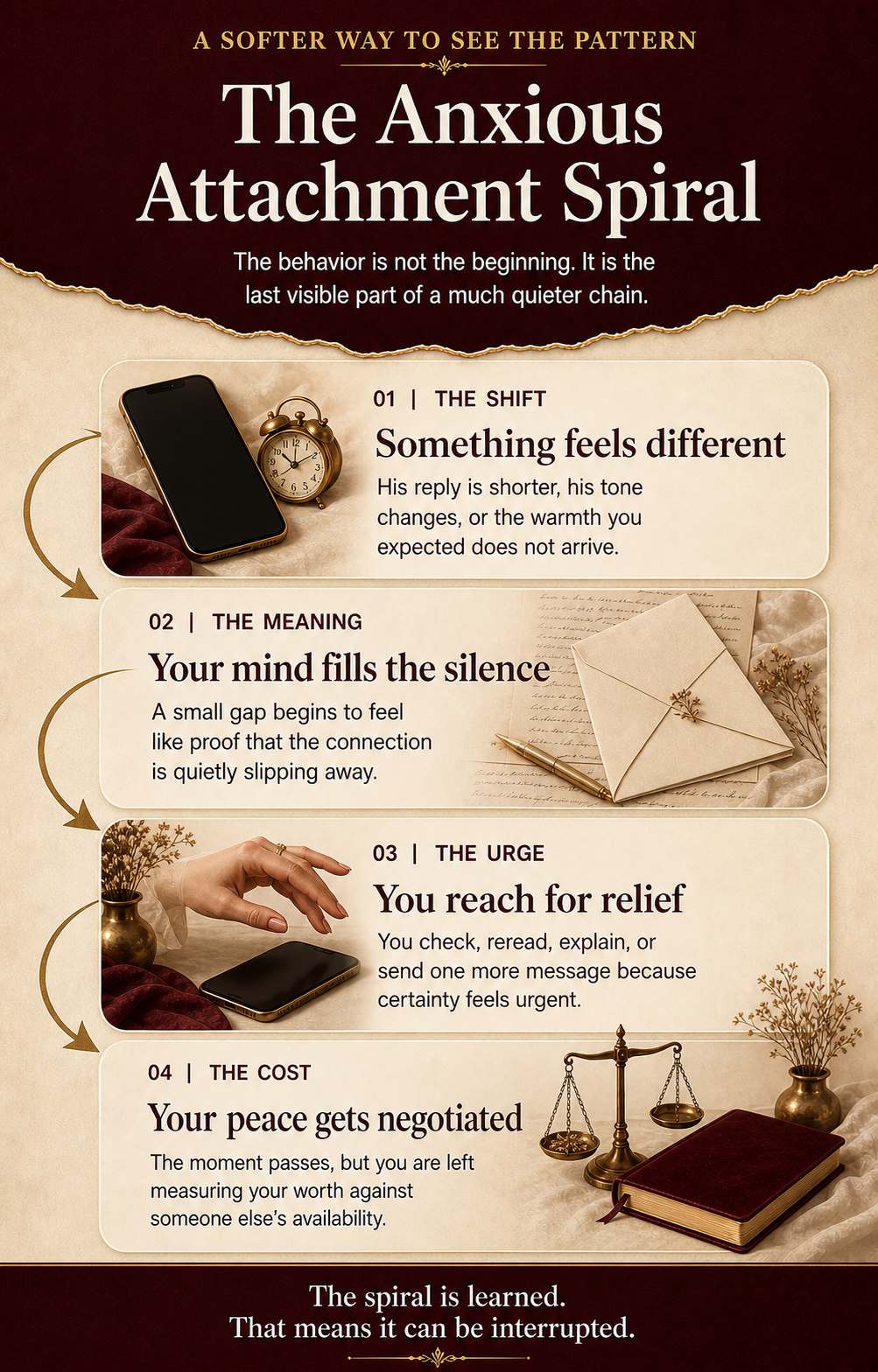
By the time you notice the behavior, your body has usually been trying to protect you for a while. A shorter reply or a tiny change in warmth becomes a story, the story creates an urgent reach for relief, and the relief leaves your peace resting in someone else's hands. This visual lets you see the quieter chain underneath the action, because the urge is rarely as random as it feels in the moment.
You confuse the man who calms you with the man who keeps you guessing
Here is how anxious attachment shows up in relationships in the cruelest way. The available man, the one who texts back, who plans ahead, who is simply there, can start to feel a little flat. Meanwhile the inconsistent one lights up every nerve you have. You mistake the activation for chemistry. You mistake the relief of his occasional attention for love. And so you keep choosing the very dynamic that confirms your fear, then wondering why love always seems to ache.
If you have ever wondered why you keep ending up with the one who pulls away, it is worth understanding the anxious and avoidant pairing that traps so many women, because the chemistry you trust the most may be the thing leading you somewhere you do not want to go.
If more than a few of these feel like reading your own diary, The Intimate Clarity Bundle has the language for the conversation that finally breaks the cycle.
Get the BundleYou shrink your needs to fit the space he offers
If he can only give a little, you teach yourself to want a little. You become an expert in making do, in calling crumbs a meal, in being the low-maintenance woman who never asks for more than she is given. You do this so quietly that you barely notice yourself doing it, until one day you realize you have no idea what you actually need anymore, only what you have trained yourself to settle for.
A woman who continually makes herself smaller will eventually disappear into a relationship that never had room for her in the first place. The shrinking does not keep him. It just slowly erases you.
You replay conversations looking for where it went wrong
After a slightly off interaction, you run it back. What did you say. What did he mean. Was it the joke, the silence, the thing you brought up too soon. You audit yourself with a thoroughness you would never apply to anyone else, always landing on the same verdict, that the wobble in the connection must somehow have been your doing.
This relentless self-review feels like accountability. It is not. It is the fear convincing you that if you can just find your mistake, you can prevent the loss, and so you keep grinding over moments that were never yours to fix.
You let one cool text reorganize your entire day
A single clipped reply lands, and suddenly you cannot focus on your work, your friend's story, the show you were enjoying. The whole day bends around that one small thing. When anxious attachment is triggered, it does not politely wait until you have a free moment. It commandeers the foreground and leaves you trying to function while half of you is somewhere else, interrogating a message that probably meant nothing at all.
You are giving a man who sent six words the power to set the weather for your entire day. That is not devotion. That is a fear that has been allowed to hold the steering wheel for far too long.
You push him away to see if he will stay
Sometimes the fear gets so loud that you do the strangest thing of all. You create the distance yourself. You pick the small fight, you withdraw the warmth, you say the cool thing, almost daring him to leave so you can stop dreading the leaving. It is the heartbreaking logic of a nervous system that would rather control the rejection than be ambushed by it.
The trouble is that some men will simply walk through the door you held open, and then you are left holding proof of the very thing you feared, never knowing it was the fear, and not the love, that opened the door.
You treat his reassurance as a thing you have to earn
Underneath all of it sits the quietest belief of all, the one that runs the whole machine. Somewhere you decided that love is not freely given but earned, that you have to be good enough, easy enough, low-maintenance enough to deserve someone's steady presence. So you perform, and you monitor, and you shrink, all in service of an audition that was never actually being held.
The work, if you are ready for it, is not to become a woman who needs less. It is to soothe the fear without pretending you do not care, and to learn, slowly, that the right love was never something you had to earn by disappearing. As that lesson begins to land, you may start noticing the quiet signs your attachment is becoming secure in places that once felt impossible. Where you are now is exhausted from auditioning for a part you already had. Where you could be is resting inside a love that asks you only to show up as yourself, monitoring nothing, bracing for nothing, finally able to put the rope down. The distance between those two places is mostly made of words you have never had, the ones that let you ask for what you need without the apology folded in. The Intimate Clarity Bundle was built to put exactly those words in your hands, so the next time the fear rises, you reach for language instead of reaching for the old patterns you swore you were done with.