
They look the same from the outside. No label, no formal commitment, time spent together, feelings involved. But one of them has a foundation and the other one does not. That difference is everything.
The question of situationship vs friends with benefits comes up often because the two arrangements share so many surface features. Neither has an official title. Neither involves a formal commitment. Both include intimacy of some kind and time spent together that can feel genuinely close. Someone watching from the outside might not be able to tell which one you are in. But you can feel the difference, even when you cannot name it yet.
The difference between a situationship and friends with benefits is not really about what happens between the two people. It is about what was agreed to before anything happened. Friends with benefits is a defined arrangement, casual and clear. A situationship is undefined by design, which is precisely where the pain lives. When women ask whether a situationship is like friends with benefits, the honest answer is that it looks similar but costs significantly more, because one of them carries hope and the other one was never supposed to.
These twelve points break down exactly where the two things diverge, starting with the question that shapes everything else.
The agreement that defines one and the silence that defines the other
Friends with benefits, when it functions the way it is supposed to, begins with a conversation. Both people acknowledge what they are doing and why. They are choosing a casual arrangement with clear enough terms that neither person has to wonder what the other expects. The clarity is not romantic but it is honest, and that honesty is what makes it possible to participate without the ongoing anxiety of not knowing where you stand.
A situationship begins with no such conversation. The connection develops, the intimacy arrives, and the definition never comes. Both people continue without agreeing to anything, which means both people are operating on assumptions that may not match each other's. The woman in a situationship is almost always assuming more than the man has agreed to. That gap between what is assumed and what was actually agreed is the source of most of the pain that comes later.
Hope: absent in one, quietly central in the other
A genuine friends with benefits arrangement does not carry hope of becoming something more. That is not a failure of the arrangement. It is the design. Both people understand that what they have is what they agreed to, and the satisfaction of that arrangement does not depend on it becoming something else. There may be warmth, and even genuine affection, but the forward-facing hope of a future commitment is not present because both people agreed it was not the point.
A situationship almost always carries hope. That is, in fact, one of the clearest ways to tell which one you are in. If you are hoping this becomes a relationship, if you are monitoring his behavior for signs that it might, if you are measuring his warmth against the possibility of something more formal, you are in a situationship. The hope is what makes the situationship vs friends with benefits distinction so important, because hope changes the entire emotional stakes of the arrangement and neither person has agreed to those stakes out loud.
What the talking stage has to do with both of them
The talking stage is the period of getting to know someone with the mutual, if unspoken, understanding that you are both evaluating whether this becomes something real. It has a direction to it. Both people understand they are moving toward a decision. The difference between the talking stage and a situationship is essentially what happens when that evaluation never resolves. A talking stage that goes on for four months without becoming a relationship or ending cleanly has become a situationship. The forward motion stopped, the intimacy continued, and nobody said anything about the change.
Women ask about the situationship and talking stage difference for exactly this reason: it is easy to keep calling something a talking stage long after it has stopped being one. This matters because women sometimes think they are still in a talking stage when they have long since moved into situationship territory. The talking stage implies progress. The situationship implies stasis. If you have been talking for longer than it would reasonably take to decide whether you like someone, and still no decision has been made, the talking stage ended a while ago.
If the first three points have already placed you somewhere specific, The Intimate Clarity Bundle has the exact words for the conversation that moves things off stasis and toward a real answer.
Get the BundleA fling versus a situationship: duration and emotional investment
A fling is time-limited and both people usually know it. There is a naturalness to its ending that does not require a formal conversation because the terms were never serious enough to require one. Two people enjoyed each other for a period of time, the period ended, and both moved on without significant damage. The fling vs situationship distinction is mostly about duration and the level of emotional investment that accumulates over time.
A situationship lasts long enough to matter. Long enough that her weeks are organized around his availability. Long enough that she has introduced him into her internal world in ways that will take real time to undo. A situationship is not a fling that went on too long. It is a different kind of thing entirely, defined by the ongoing emotional investment that made leaving feel impossible even as it became increasingly necessary.
The hookup that stays vs the situationship that started casual
Some situationships begin as something more casual, a hookup that kept happening, a situation that was supposed to stay light and did not. What makes a situationship vs hookup comparison complicated is that the hookup itself is usually simple: both people were clear about what it was. The complication arrives when one person develops feelings that were not part of the original arrangement and does not say so, while continuing to participate as if the original terms still apply.
By the time a woman realizes she is in a situationship rather than a casual hookup arrangement, she has already invested enough that the casual framing stopped being accurate weeks or months ago. The man may still be operating under the original casual understanding. She has moved into something that looks, from her side, like a real connection. Neither of them has updated the terms out loud, which is how the situationship solidifies around a gap neither person has directly addressed.
You deserve to know exactly what you are in.
One honest letter a week on love, patterns, and the conversations worth having. For the woman who is done guessing what something is while hoping it becomes something else.
You are in.
Your first letter is on its way. Check your inbox.Why the situationship hurts more when it ends
When a friends with benefits arrangement ends, the grief is manageable because the expectations were always clear. Both people knew what they were in. The ending is sad in the way that any connection ending is sad, but it does not carry the particular devastation of losing something you had been hoping would become more. You grieve what was, not what you had been building toward without agreement.
When a situationship ends, you are grieving on two levels simultaneously. You are grieving the actual connection, the mornings and the conversations and the version of yourself that felt almost chosen. And you are grieving the potential, the relationship that kept implying it was almost here and never arrived. Getting over a situationship hurts more than most people expect because the grief is doubled in this way, and neither part of it has a social script that recognizes it as a real loss.
The distinctions above tend to blur when you are inside one of these arrangements. The breakdown below puts the key differences side by side so the picture stays clear.
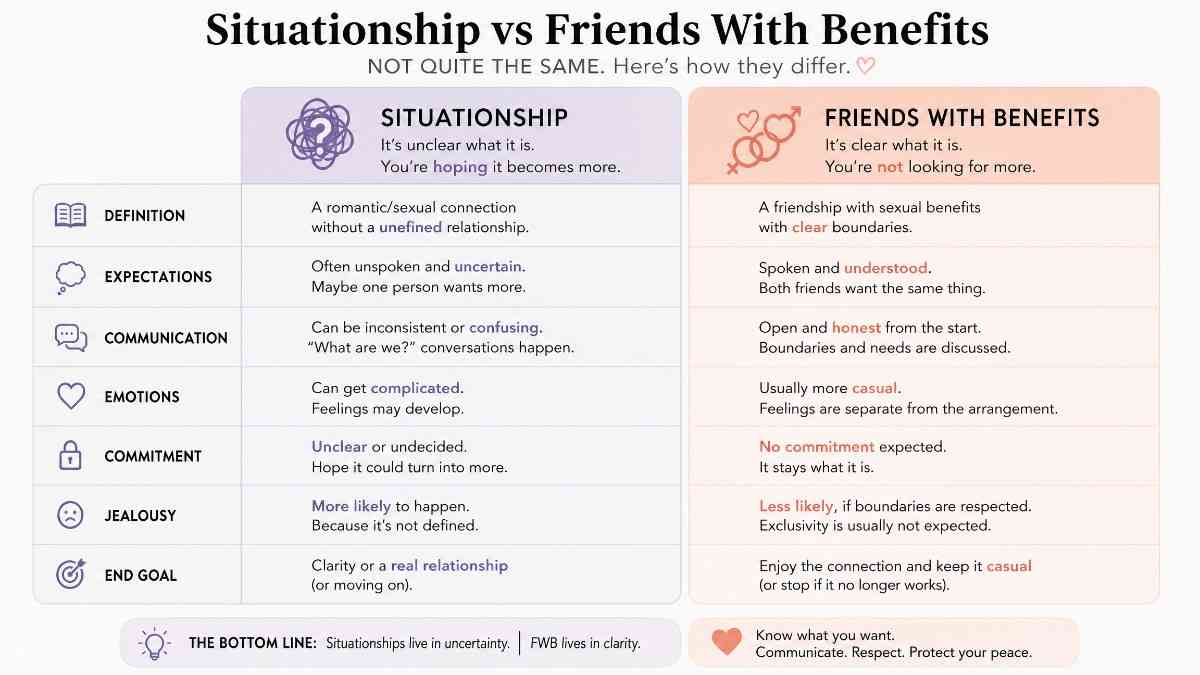
The slow burn that never ignites
Women sometimes describe their situationship as a slow burn, and there is real accuracy to that description. The connection builds gradually, the warmth deepens, the intimacy accumulates, and there is a feeling throughout that this is all leading somewhere. The slow burn implies eventual heat. It implies that the patience is building toward something real. What distinguishes a genuine slow burn from a situationship is whether the building is actually happening or whether what feels like progress is just the same level of warmth maintained indefinitely.
A slow burn that keeps burning without ever becoming anything is not a slow burn. It is a situationship with a more romantic name. The honest test is whether the relationship has structurally changed over the time it has been developing. Not whether the feelings have deepened, which they often do in situationships too, but whether the terms have changed. If nothing about the actual arrangement has shifted in three months, the slow burn narrative is a story you have been telling yourself to make the stasis feel more purposeful than it is.
If point seven sounds familiar, The Intimate Clarity Bundle has the exact language for the conversation that finds out whether the slow burn is going somewhere or whether you have been waiting at a fire that was never going to be lit for you.
Get the BundleWhat friendship has to do with it
Some women describe their situationship as starting from a friendship, and this adds another layer of complexity to the situationship vs friendship comparison. When the connection has a genuine friendship at its base, leaving the situationship feels like losing two things at once: the romantic connection and the friendship that preceded it. The man often leans into this, consciously or not, by keeping things warm and friendship-adjacent enough that ending the situationship feels like an overreaction to something he never formally offered.
The friendship framing is also how situationships survive longer than they should. She does not want to blow up a friendship. She tells herself she can manage the feelings. She stays adjacent to someone who is using the proximity of the friendship to maintain access without ever making a decision. The friendship does not protect her. It just makes the exit harder to take.
Casual dating versus being permanently undefined
Casual dating, like friends with benefits, works when both people understand what they are doing. Two people are spending time together without committing to anything serious, and both of them have some awareness of that fact. Casual dating vs situationship is a distinction worth understanding because casual dating, even when it does not lead anywhere, does not tend to leave the same kind of damage. You were never under the impression you were building toward something. You were just seeing what was there.
A situationship is not casual dating. It is a connection that presents itself as something more than casual, that carries the emotional investment of something more than casual, that asks you to be available in ways that are decidedly not casual, while never formally committing to being anything at all. The casualness of a situationship is not mutual. One person is invested seriously. The other person is benefiting from that investment without acknowledging its terms.
What the situationship asks of you that friends with benefits does not
A friends with benefits arrangement, properly managed, does not require you to perform anything. You are not trying to make yourself indispensable. You are not monitoring his behavior for signs that the arrangement is evolving. You are not editing your personality to keep him interested without triggering his desire for distance. The terms are clear enough that you can simply show up as yourself within them.
A situationship asks significantly more of you. It asks you to be available without asking for availability in return. It asks you to invest without asking him to invest equally. It asks you to perform an easiness you do not actually feel because showing the real level of your investment would require a conversation about terms that neither of you has had. The situationship extracts real emotional labor under the cover of something that was never agreed to be serious. The signs of a situationship almost always include this particular asymmetry once you learn to see it.
The exit: clean in one, complicated in the other
Leaving a friends with benefits arrangement, when both people have been honest about what it was, is relatively clean. The terms are clear so the ending of those terms is clear. There may be sadness but there is not the particular confusion of not knowing what you are actually losing, because you always knew what you had.
Leaving a situationship is complicated precisely because the terms were never established. Ending a situationship without losing your dignity requires you to define something on your way out that was never defined on the way in. You have to name what it was in order to name that it is over. That naming, which requires more honesty and courage than the situation ever asked of either of you while it was happening, is what most women find so difficult about getting out cleanly.
The one question that tells you which one you are in
If you want to know right now whether you are in a situationship or something more clearly defined, there is one question that cuts through all of it: have both of you explicitly agreed to what this is? Not implied it. Not assumed it. Not hoped for it. Agreed to it, out loud, in a real conversation where both people said yes to the same terms.
If the answer is yes, you have a defined arrangement, whatever its terms happen to be. If the answer is no, you are in a situationship, regardless of how warm it feels or how long it has been going on. Asking yourself honestly whether you are in a situationship is the beginning of knowing what to do next. The arrangement you deserve is one where both people have looked at each other and chosen it deliberately. That is not a high bar. It is the minimum.