
Most of what an anxious heart needed to hear, no one ever said. So it learned to ask in the only language panic understands, and then it was called too much for asking. If you keep asking, what does anxious attachment need to feel safe, start here.
For the full foundation, read our complete guide to anxious attachment.
There is a specific loneliness in loving the way you love. You feel everything at full volume, you reach for closeness without much armor, and somewhere along the way you learned that the size of your feeling was a problem to be managed rather than a tenderness to be met. So you got quiet about it. You started pre-apologizing. You learned to translate the simple wish to be held into something smaller and more acceptable, and the translation cost you something every single time.
What does anxious attachment need? Not constant attention, despite what the takes imply. It needs a handful of true things said plainly and often enough to be believed, the reassurances that would have changed everything if anyone had offered them when it mattered. The trouble is that almost no one says them, and so the anxious nervous system fills the silence with worst-case stories and then gets blamed for the stories it told.
These are twelve of those things. Read them as the words you were owed and rarely received. Some of them are for you to hear, and some of them are for you to finally say to yourself, because the voice that learns to say them is the voice that begins to calm.
What does anxious attachment need? Start with this truth
Start here, because everything else rests on it. The wish to be close, to be chosen consistently, to know you matter to the person you love, is not a defect. It is the most ordinary human longing there is, and you happen to feel it without the layer of detachment that lets other people pretend they do not. Somewhere you absorbed the idea that needing closeness made you weak or excessive. It did not. It made you honest about what every person alive actually wants.
The culture that told you to want less was not offering you wisdom. It was offering you a smaller life dressed up as maturity. Wanting closeness is not the thing to fix. The shame about wanting it is.
The silence you fill with worst-case stories is not a prophecy
Ellen knew the feeling by heart. He would read the message and not answer, and within twenty minutes she had constructed an entire narrative: he was pulling away, he had met someone, she had said the wrong thing, this was the beginning of the end she had always known was coming. By the time he texted back something ordinary an hour later, she had lived through a small grief for a loss that never happened. The anxious mind treats a delay in a text as evidence, when it is almost always just a delay.
When the silence stretches and the spiral starts, the truest thing to tell yourself is this: a gap in contact is a gap in contact, not a message about your worth. His quiet is usually about his day, his meeting, his low battery, his ordinary human distractedness. The story you write in the gap feels like information, but it is only fear, narrating. You do not have to believe the narrator just because she is loud. If you want to notice the smaller habits that grow around that fear, read about the things anxious attachment quietly makes you do before you mistake them for your personality.
Needing reassurance once does not make you a burden
You have probably swallowed the question rather than ask it, because asking felt like proof of the very neediness you were trying not to be. But a single honest request for reassurance is not a burden. It is intimacy functioning correctly. The person who loves you would rather know what you need than watch you perform a calm you do not feel.
The burden story is one of the cruelest things the anxious mind tells, because it keeps you from the exact thing that would soothe you. You are allowed to say, this silence is hard for me, can you tell me we are okay. That is not too much. That is a person being honest about her own heart.
If you have been swallowing the question instead of asking it, The Intimate Clarity Bundle gives you the words to ask for reassurance without the apology that used to come first.
Get the BundleThe way you pull or protest is a bid for safety, not an attempt to push him away
This is the one that needs saying most, because it is the one most often misread. When the distance opens up and you get sharp, or text again, or go cold to see if he notices, it looks from the outside like you are pushing him away. People will tell you that this is exactly how anxious attachment pushes people away, and there is a painful grain of truth in it, because the behavior can overwhelm a partner who does not understand it. But the intention is the precise opposite of pushing away. It is a desperate reach toward, a bid that says please come back, please tell me we are safe, in the only language the panic knows.
Understanding this changes what you do with it. The goal is not to hate the impulse but to learn a gentler way to make the same bid. The reach for safety is human. The form it takes is the part that softens with practice, once you can name what you are actually asking for underneath the protest.
Your love shows up as attention, and that absolutely counts
You may have wondered whether you even love well, given how much fear gets tangled into it. So hear this plainly: anxious people show love through attention, anticipation, and presence. You remember the small things. You notice the shift in his mood before he says a word. You orient your care toward the people you love with a completeness most of the population has quietly given up on. That is not anxiety masquerading as love. That is love, expressed through the very attentiveness your wiring made possible.
The fear and the love come from the same sensitivity. When the fear quiets, the attentiveness does not disappear. It just stops being braided with dread, and what is left is one of the most generous ways a person can love another person.
The reassurance you needed, offered once a week.
Every week, one honest letter on love, patterns, and the conversations worth having. Written for the woman who is learning that her heart was never the problem.
You are in.
Your first letter is on its way. Check your inbox.A trigger is old, not current
When anxious attachment is triggered, the feeling arrives with total conviction that the danger is happening now. The panic does not announce itself as a memory. It announces itself as an emergency. But the intensity is the tell. When a present-day situation produces a reaction far larger than the situation warrants, you are not responding to the present. You are responding to the past, layered on top of the present so seamlessly that they feel like one thing.
The most freeing sentence you can learn is this: this feeling is old. The size of it belongs to a younger version of you who once had real reason to panic about closeness. Naming the feeling as old does not make it vanish, but it creates a sliver of space between you and the reaction, and that sliver is where every choice you have ever wanted to make instead lives.
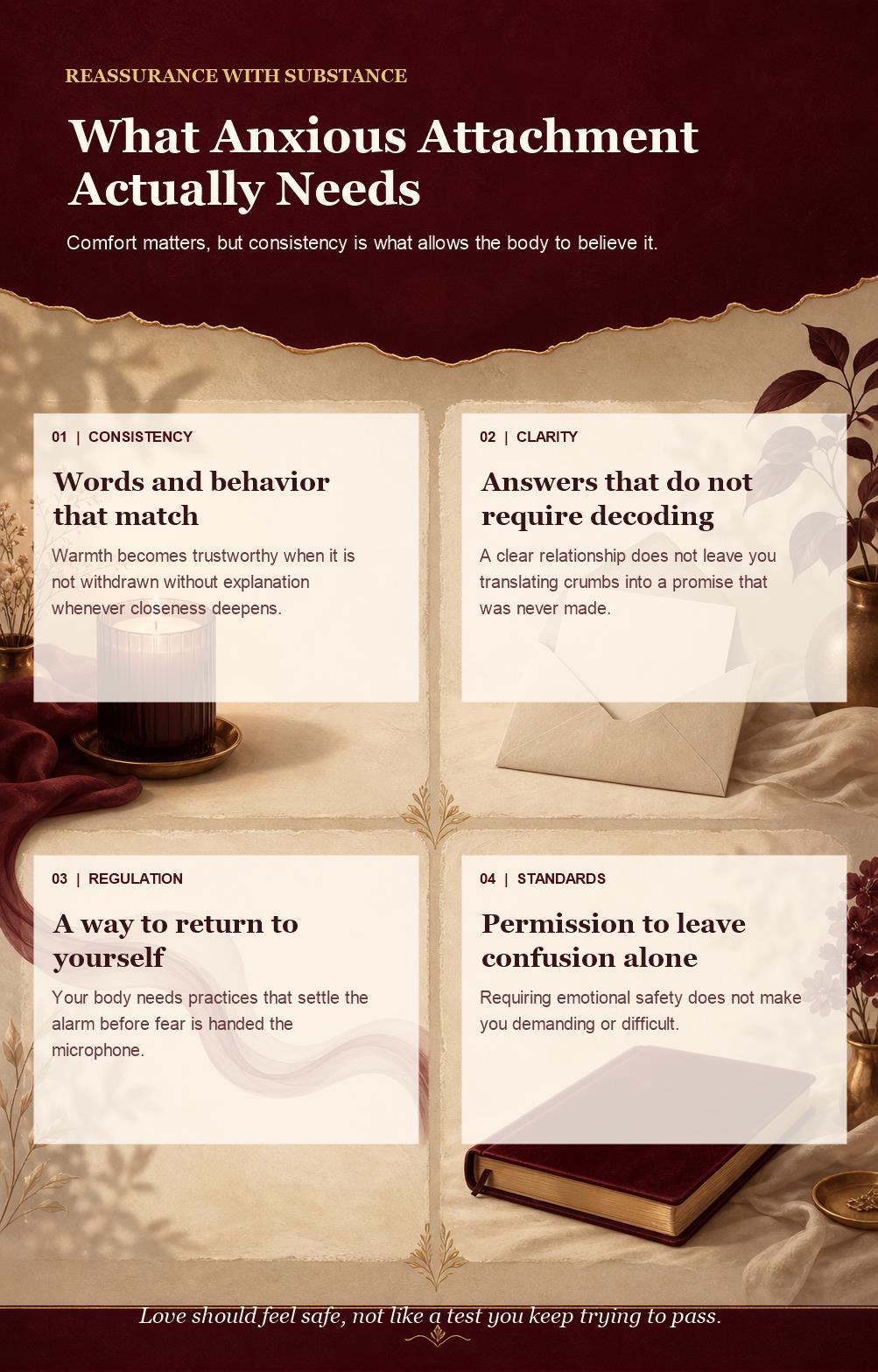
An anxious nervous system does not need another beautiful promise that disappears as soon as closeness becomes inconvenient. It needs steadiness it can actually feel in the relationship, and it needs a way to return to itself when an old fear begins speaking louder than the present moment. This small map brings those needs into view.
You are allowed to ask directly
So much of the anxious strategy is indirect. You hint, you test, you go quiet to see if he chases, you manage your face so he will not see how much you need to know. The indirectness comes from a reasonable fear that asking directly will make you look needy or scare him off. But the indirect route is the one that actually causes the trouble, because it asks him to decode you instead of simply hearing you.
Directness is the gift you have been withholding from yourself. Can we talk about where we are. I felt anxious when I did not hear from you, and I would love to understand what happened. These are not needy sentences. They are clear ones, and clarity is the thing that lets a steady person actually meet you.
If you are ready to trade the hinting and testing for words that say what you mean, The Intimate Clarity Bundle holds the scripts for asking directly without losing your warmth.
Get the BundleHis distance is not always about you
The anxious mind is a relentless self-referencer. When he is quiet, withdrawn, or off, the immediate assumption is that you caused it, that you did something, that the distance is a verdict on you. But people go quiet for a thousand reasons that have nothing to do with their partner. He is tired, he is stressed about work, he is in a mood that predates you and will pass without your intervention.
Learning to let his distance be his own is one of the deepest forms of relief available to you. Not everything is a referendum on whether you are loved. Sometimes a person is just having a day, and the most loving thing you can do, for him and for yourself, is to let him have it without making it mean something about you. The distinction becomes especially important when you are caught inside the anxious and avoidant attachment loop, where one person's need for space can amplify the other person's fear.
You do not have to earn a reply
Somewhere in you lives the belief that connection must be earned, that you have to be interesting enough, easy enough, low-maintenance enough to deserve a response. So you craft the perfect text, you wait the strategic amount of time, you perform an ease you do not feel, all to earn a reply that should simply be yours in a relationship where you are valued. The earning is exhausting, and it is built on a lie.
You do not have to earn basic responsiveness from someone who claims to want you. It is supposed to be freely given. If you find yourself constantly auditioning for a reply, the problem is rarely your performance. It is either the panic distorting your read of a normal situation, or a real imbalance worth looking at honestly. Either way, you were never meant to earn your place in a good connection.
You can want a label and still be calm about it
You have been told that wanting definition is needy, that the calm thing is to go with the flow and not ask what you are. But wanting to know where you stand is not the same as being frantic about it. You can hold the desire for clarity with a steady hand. You can say you would like to know where this is going, and then let the answer be the answer, without it becoming a referendum on your worth.
The calm comes from a quiet certainty that you will be okay regardless of the response. That certainty is built over time, but it begins with the recognition that wanting commitment is not a flaw to hide. It is a legitimate desire you are allowed to state plainly, and a person worth your love will not be scared off by a woman who knows what she wants.
The panic is survivable, and it is brief
In the grip of an attachment spiral, it feels like the feeling will never end, like the only way to make it stop is to do something, send something, get the reassurance immediately or die. But the wave of panic, if you let it move through you without acting on it, crests and falls faster than you expect. The discomfort is real and it is also temporary, and you have survived every single one of these waves so far.
This is worth knowing in your body, not just your head. The next time the spiral hits, you can set the phone down, breathe, and let the wave pass without obeying it. Each time you do, you teach your nervous system a new truth: the feeling does not require action, and you are bigger than the panic that visits you.
You were never too much for the right nervous system
Hold this one last, because it is the one that heals. Everything you were told was too much, the intensity, the attentiveness, the wish for closeness, the feeling at full volume, was only ever too much for people who could not meet it. With a steady person, with a regulated nervous system that does not flinch at warmth, the very things you were shamed for become the things that are treasured. The same depth that overwhelmed the wrong person is what the right person calls a gift.
You do not have to become smaller to be loved. You have to stop offering your heart to people who were never going to be able to hold it, and learn to recognize the steadiness that can. When you do, you will discover that the woman you were told to fix was, all along, simply waiting for the difference between fear and being genuinely loved to finally show up in her own life. And it can. Attachment patterns move toward security, and the heart you have been apologizing for is more capable of that steadiness than anyone ever told you, as you will see in the quiet signs your attachment is becoming secure.