
Anxious vs avoidant attachment can feel like chemistry with a pulse in it. The room brightens when he comes closer, then the silence after he retreats sits in your chest like a held breath. The intensity feels meaningful because your body is working so hard to keep the connection alive. That does not automatically make the connection safe.
For the full foundation, read our complete guide to anxious attachment.
I have watched women call this dynamic fate because the pull feels so specific. A steady man can seem almost too quiet after a relationship built around waiting, decoding, and the sudden relief of his return. Yet the anxious and avoidant attachment loop is not proof that two people belong together. It is often the moment when two protective patterns recognize each other and begin pressing on the bruises neither person knows how to name.
The point is not to turn him into a villain or to shame you for wanting closeness. It is to look directly at what happens between you, because softness is only beautiful when it is not being used to survive uncertainty.
Anxious attachment moves toward closeness; avoidant attachment moves away from it
When a woman with anxious attachment senses distance, her instinct is to close the gap. She notices that his voice sounds flatter, or that the plan for Friday has become vague, and her body leans toward the conversation before she has decided what she wants to say. Closeness feels like the place where the alarm might finally settle.
An avoidant partner often feels the same tension and reaches for the opposite form of relief. He may become quieter, postpone the conversation, or ask for space without explaining what the space is meant to hold. Distance helps him feel less engulfed. The first painful juxtaposition is simple: the thing that calms one person can frighten the other.
She reads the pause as a warning; he reads her question as pressure
It can begin with something so ordinary that neither person recognizes the pattern at first. His reply takes longer than usual. She asks whether everything is okay. He hears an expectation he does not feel ready to meet, so his answer becomes even shorter. She feels the temperature drop and begins searching for the sentence that will restore the warmth.
This is where the things anxious attachment quietly makes you do can start to feel like personality instead of protection. You reread, explain, soften, and send one more message. He experiences the extra effort as another reason to retreat. Neither person receives the reassurance they were trying to create.
She wants to resolve the tension tonight; he wants to revisit it when the feeling has cooled
Time behaves differently inside each pattern. For the anxious partner, an unresolved conflict can fill the whole room. She lies beside her phone with the screen turned down, promising herself she will not check again, while every small sound in the apartment seems louder than it should. Waiting does not feel neutral. It feels like the relationship is quietly slipping out of reach.
The avoidant partner may genuinely believe that distance will prevent the conversation from becoming worse. He wants the emotional heat to come down before he speaks. The trouble begins when his pause has no tenderness around it, no clear return point, and no reassurance that the relationship still matters. Space without care becomes ambiguity, and ambiguity is precisely what the anxious nervous system struggles to carry.
If every difficult conversation becomes a choice between chasing him and swallowing your feelings, The Intimate Clarity Bundle gives you language that stays warm without abandoning the point.
Get the BundleShe seeks reassurance through contact; he seeks regulation through distance
Reassurance does not mean the same thing to both people in this pairing. She feels steadier when words and behavior match, when a difficult moment is named plainly, and when she does not have to excavate a basic answer from a pile of mixed signals. He may feel steadier when he is not being asked to respond while emotion is still close to the surface.
The question is not whether either need is shameful. The question is whether the relationship has enough maturity to hold both needs without making one person disappear. If you are still trying to work out whether the alarm is taking over the relationship, these honest signs of anxious attachment can help you recognize the pattern without turning yourself into the problem.
Her nervous system can mistake relief for romance; his return can feel more intimate than it is
The high point of the cycle is not always the beginning. Sometimes it is the reunion. He goes quiet long enough for the ache to sharpen, then returns with warmth, a soft voice, or the kind of message that lets your shoulders fall for the first time in three days. The relief moves through your body so quickly that it can feel like proof of an extraordinary bond.
Relief is real, but relief is not the same thing as safety. If you have spent long enough confusing intensity with intimacy, the difference between anxious attachment and genuine love matters. A safe relationship can still feel romantic and deeply alive. It simply does not require a small emotional emergency before tenderness appears.
For the woman who is done mistaking activation for love.
Every week, one honest letter on love, patterns, and the conversations worth having. Written for women learning to tell the difference between chemistry and an old wound.
You are in.
Your first letter is on its way. Check your inbox.She may shrink herself to keep him comfortable; he may accept the smaller version without noticing the cost
Brooke did not begin her relationship with Ethan as a woman afraid to speak. At the beginning, she was playful, direct, and easy in her own skin. The change happened by inches. When she asked why he had gone quiet after an intimate weekend, he said he hated feeling interrogated. When she asked whether they were moving toward a relationship, he said labels made everything heavy. Brooke began rehearsing every sentence before she sent it, removing anything that sounded too tender, too serious, or too honest.
Ethan was not a monster. He had learned to protect himself by keeping emotional demands at arm's length. But Brooke was paying for that protection with her voice. By the time she noticed how much she had edited herself, the relationship no longer felt like love. It felt like an audition she could never quite finish.
The loop is easier to understand when you can see the order clearly. His distance activates your reach for reassurance. Your reach lands as pressure, so he creates more distance. The extra distance then feels like proof that your fear was right all along. This map is not here to blame either person. It is here to show you why the chemistry can become so exhausting.
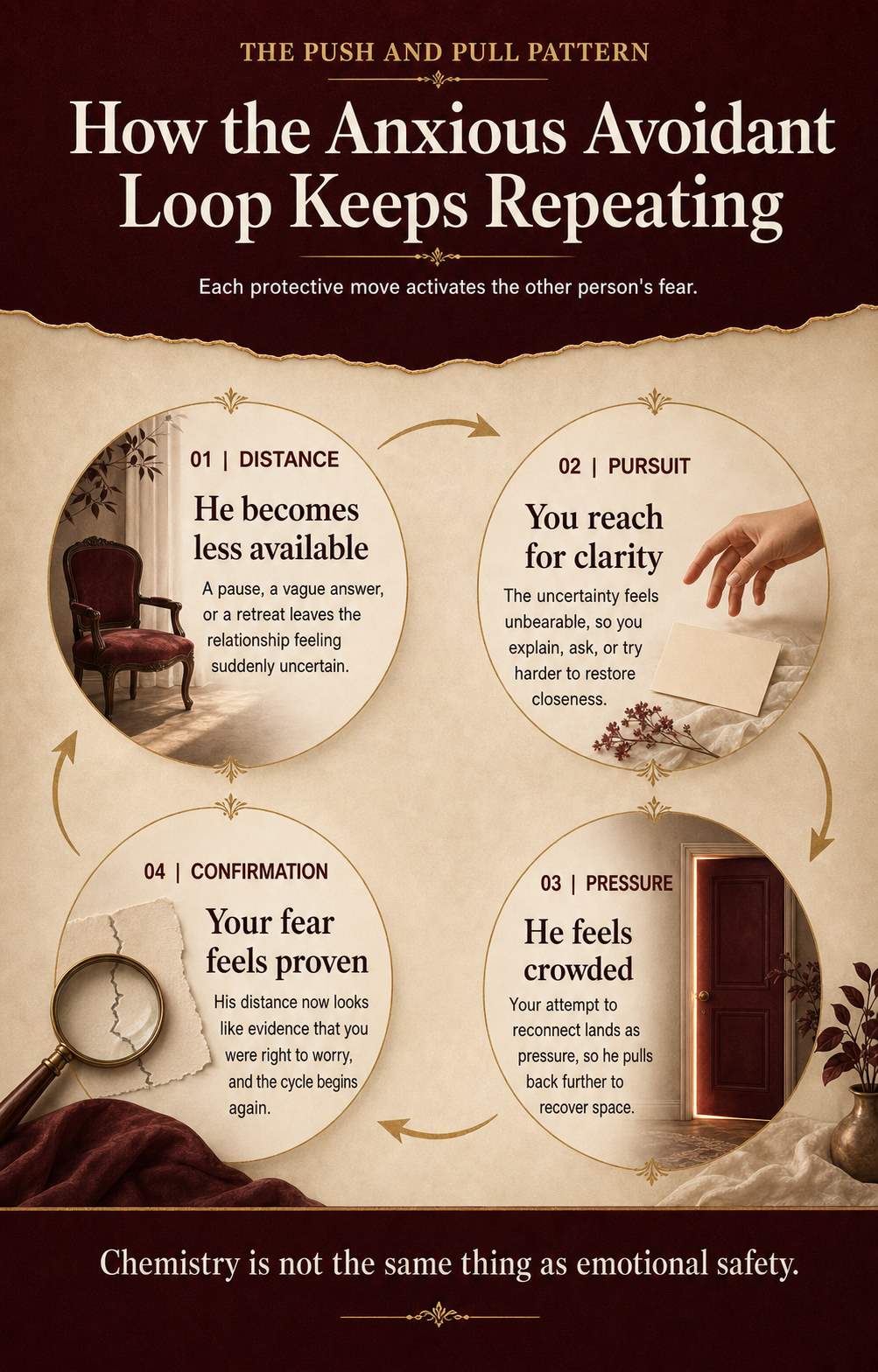
Compassion explains the pattern; it does not require you to live inside it forever
It is possible to understand why an avoidant partner retreats and still admit that the retreat hurts. His history may make closeness feel complicated. Your history may make distance feel unbearable. Both things can be true without turning the relationship into a permanent waiting room where your needs are always the ones asked to become quieter.
Compassion loses its shape when it requires self abandonment. The standard is not perfection. The standard is whether both people can recognize the pattern, take responsibility for their part in it, and make a sincere effort to create something safer than the reflexes they inherited.
If you want to speak clearly before the old reflex takes over, The Intimate Clarity Bundle gives you scripts for the moments when you need warmth and self respect in the same sentence.
Get the BundleHealthy space has a return point; avoidant distance often leaves you decoding the silence
A man can need space and still communicate with care. He can say that he wants a little time to settle, that the conversation matters to him, and that he will call tomorrow evening. The pause may not feel delightful, but it does not leave you standing in a dark hallway wondering whether the relationship still exists.
Avoidant distance often feels different because the return point remains vague. You are expected to be understanding without being given anything solid to understand. A feminine woman can respect a man's need for space, but she does not have to romanticize silence that repeatedly costs her peace.
Clarity is not chasing; it is asking once and letting his response become information
The anxious pattern can turn a valid need into a long negotiation. You ask, he gives half an answer, and you return with a softer version of the same question because you are still hoping to find the wording that will finally make clarity comfortable for him. The repetition exhausts you and allows the actual answer to remain blurred.
There is another way to hold your softness. Ask once, clearly. Let the answer include his behavior after the conversation. If you need help finding that steadier language, what anxious attachment actually needs to hear is a useful place to continue. Directness is not aggression. It is the quiet refusal to keep translating uncertainty into hope.
An apology can feel beautiful; a pattern tells you whether the relationship is changing
Brooke reached this point after one more tender reunion with Ethan. He arrived at her apartment with an apology that sounded sincere, and for a moment she wanted to let the warmth erase the previous month. Then she noticed the familiar bargain forming inside her: if she accepted the beautiful sentence quickly enough, perhaps she would not have to ask whether anything would be different.
She did not become cold. She simply slowed down. She told him that she cared about him, but she could no longer keep rebuilding trust from words alone. Ethan had the right to decide whether he was willing to show up differently. Brooke had the right to let his consistency, or the absence of it, answer the question.
Leaving the loop does not require you to stop loving him; it requires you to stop abandoning yourself
Some relationships can become safer when both people are willing to name the pattern and work on it. Others keep asking the anxious partner to do all the adapting while the avoidant partner calls his distance independence. You do not have to wait until you feel nothing before you admit that a dynamic is costing too much.
The practical work of stepping out of the cycle begins with learning how to soothe anxious attachment without pretending you do not care. The goal is not to become detached enough to tolerate anything. The goal is to become steady enough to recognize when your warmth is being met with effort and when it is being used to keep you waiting.
Secure love may feel quieter at first, but it gives your body somewhere to rest
Brooke eventually stopped measuring the relationship by the tenderness of Ethan's returns. She watched what happened after the apology, when ordinary Tuesday arrived and there was no emotional emergency to solve. His effort did not become consistent, and the answer hurt. It also released her from the exhausting belief that one more perfectly worded conversation could turn distance into devotion.
As you move out of the loop, calm may feel unfamiliar before it feels romantic. That is not a reason to run back toward intensity. It is a reason to keep noticing the quiet signs your attachment is becoming secure. Love should be able to hold your softness without making confusion the price of admission. The connection worth keeping is not the one that keeps your heart racing for proof. It is the one that lets your heart remain open without asking your dignity to stand outside the door.